

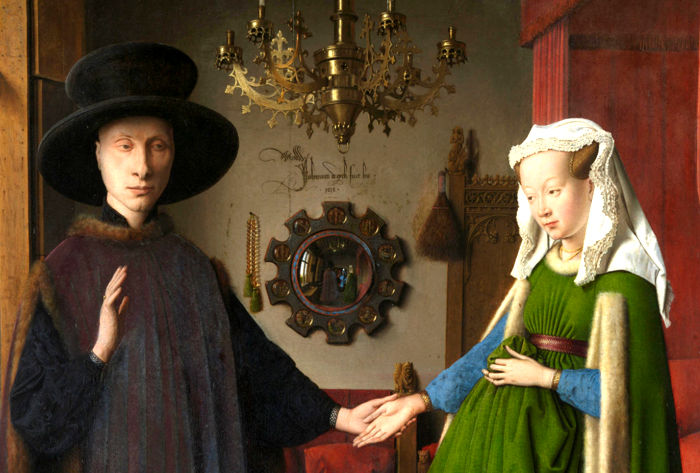
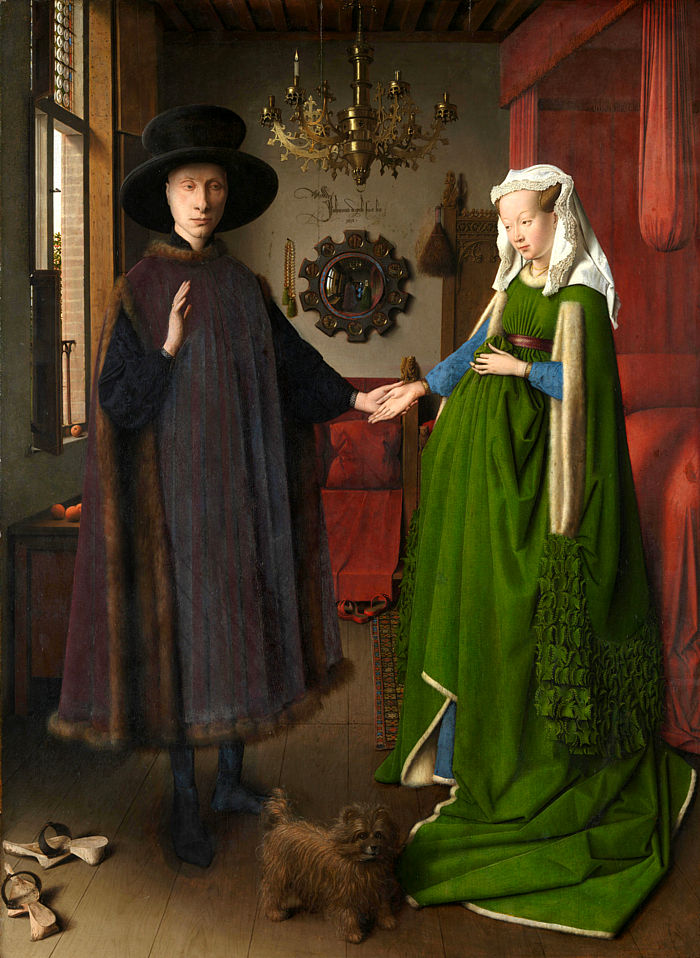
Some paintings invite quiet contemplation, and others demand to be interrogated. Painted on a modest oak panel of barely 82 by 60 centimeters, The Arnolfini Portrait (1434), now held at the National Gallery in London, belongs to the second kind. Jan van Eyck did not simply portray a man and a woman holding hands in a comfortable room: he conceived one of the most fascinating, complex and debated works in the history of art.
At first glance, the scene seems suspended in perfect calm. Light enters gently through the window and lights up the folds of the clothing and the polish of the furniture. Yet the longer you look, the clearer it becomes that every square centimeter holds a deliberate clue. Behind the protagonists, a convex mirror reflects the absent space and, above it, a signature seems to defy time. What exactly is happening in this room?
The mastery of oil: Van Eyck's revolution
To understand the impact of the work, it is essential to grasp the technical leap it represented. Van Eyck was traditionally considered the "inventor" of oil painting. Although we now know the technique already existed in more rudimentary forms, it was he who brought it to an unprecedented level of virtuosity in the Flemish Renaissance.
Unlike egg tempera, which dried quickly and forced opaque, decisive strokes, Van Eyck mixed pigments with oils and transparent resins. This allowed him to work in glazes: very thin, translucent layers applied one over another. The result is an astonishing ability to capture texture and light.
On the panel we can clearly make out the thick velvet of the man's tunic, the soft fur trim, the metallic gleam of the brass chandelier and the glassy surface of the beads hanging beside the mirror. Each material reacts to light in a different way. It is not merely a display of technique: this tactile hyperrealism turns the pictorial space into a tangible, almost three-dimensional world.
The protagonists: who is in the room?
For much of the twentieth century, the dominant interpretation, begun by the art historian Erwin Panofsky in 1934, held that the painting commemorated the marriage of the prosperous Italian merchant Giovanni di Nicolao Arnolfini and his wife Giovanna Cenami. Originally from Lucca, the Arnolfini belonged to the influential colony of Tuscan merchants and bankers settled in Bruges, the great commercial center of Flanders.
Panofsky argued that the painting worked as a visual and legal document: a marriage celebrated in private, in which the man's raised hand was an oath and the whole work served as a certificate with witnesses.
However, later research cast doubt on this theory. Giovanni di Nicolao and Giovanna Cenami married in 1447, six years after Van Eyck's death and thirteen years after the date inscribed on the panel. For that reason, the identity of the couple is now considered an open question, and the hypotheses include:
- That it depicts another member of the Arnolfini family, such as Giovanni di Arrigo Arnolfini.
- That the woman is Giovanni di Nicolao's first wife, Costanza Trenta, who is said to have died in 1433. In that case, some researchers suggest the work would be a posthumous tribute rather than a wedding celebration, although this reading is a minority view and is hotly debated.
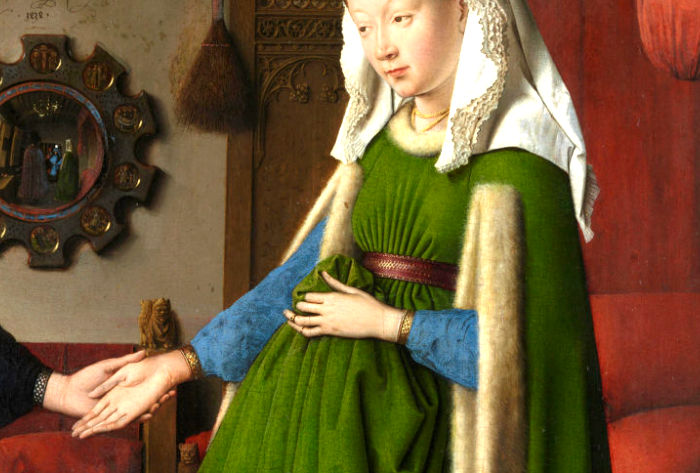
The pregnancy myth: fashion and social convention
One of the aspects that most puzzles today's audience is the female figure. The woman rests her hand on a swollen belly, which led many to think she was pregnant. However, historians of dress have explained that this is an aesthetic convention and a display of social status:
- Burgundian fashion: in the fifteenth century, the ideal of beauty praised a high waist and a prominent belly, accentuated by very full skirts.
- Excess of fabric: her green dress required yards of fine, heavy cloth. The woman gathers the fabric in her lap to show off the sumptuousness of the material and the fur lining.
- Fertility as a virtue: the pose evokes fertility as a desired marital value, without implying an actual pregnancy at the time of the portrait.
The secret language of objects
In Flemish art, everyday life is charged with what Panofsky called "disguised symbolism": ordinary objects that at the same time carry religious, moral or social meanings.
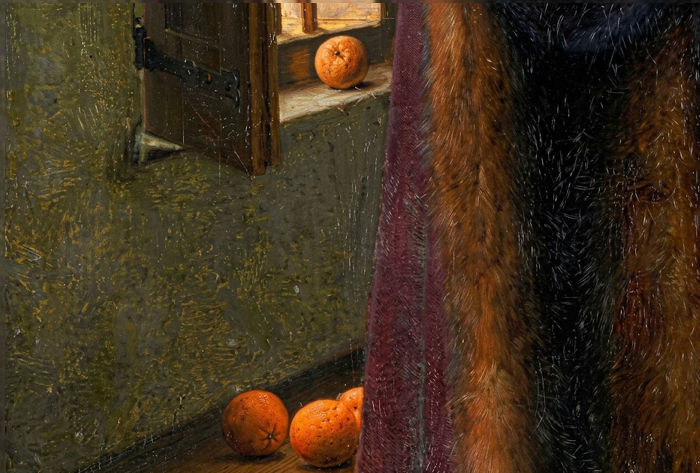
The oranges
Several oranges lie beside the window and on the chest. In fifteenth-century Flanders, citrus fruits were not grown locally and were imported at a very high cost. Their presence proclaims the purchasing power and trade networks of the Arnolfini. On a symbolic level, some scholars have also linked them to earthly paradise and the innocence before the Fall.
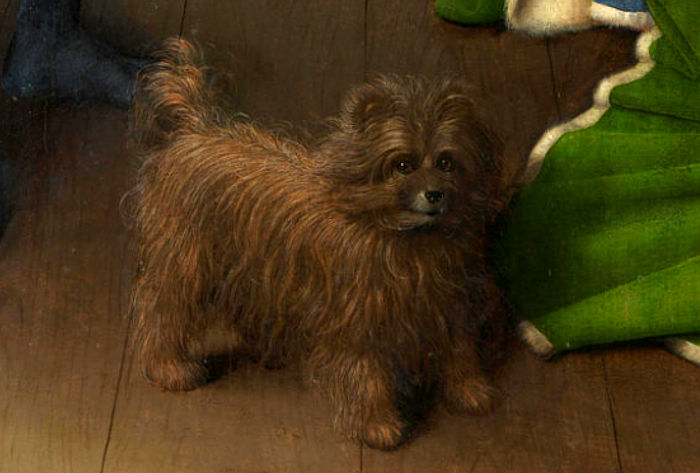
The lapdog
In the foreground, at the couple's feet, rests a small griffon-type dog. Beyond its charm, the dog is a traditional emblem of marital fidelity. Its meticulous fur also shows the patience with which Van Eyck worked every detail.
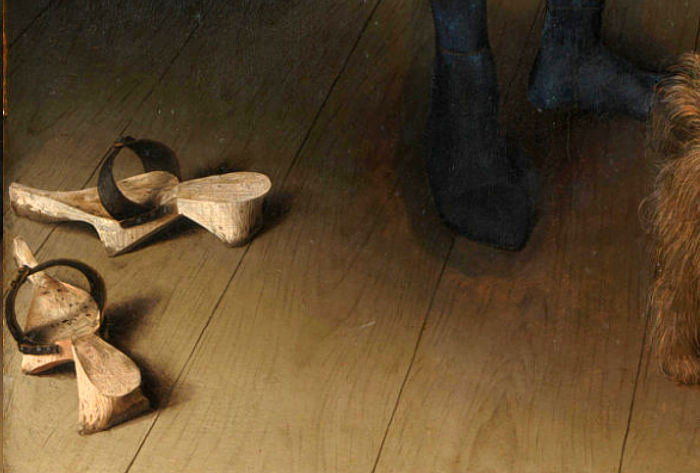
The removed clogs
In the foreground, on the left, lie a pair of wooden clogs that have been taken off. Removing one's shoes recalls the biblical passage of Moses before the burning bush: "Take off your shoes, for the place where you are standing is holy ground." According to this reading, the domestic room is raised to a sacred space.
The red slippers
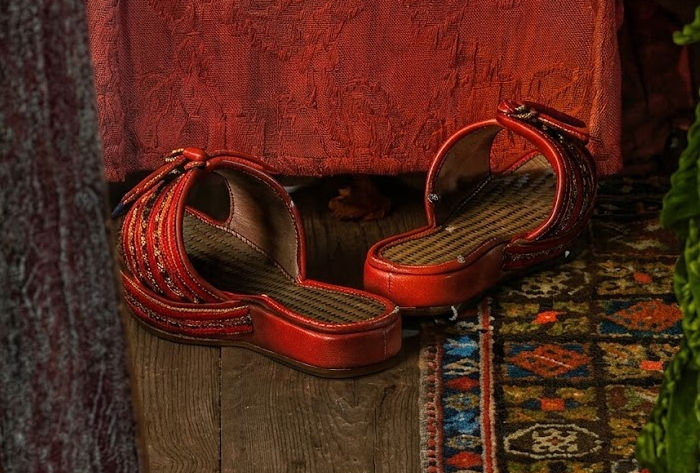
Farther back, at the rear of the room, a pair of red slippers can also be seen, far more discreet than the clogs in the foreground. The clogs were outdoor footwear, meant to protect shoes from the mud of the streets, and leaving them at the door was an everyday gesture. Although Panofsky saw in the removed footwear a biblical allusion, other specialists consider it simply a realistic detail of domestic life. There is no specific symbolic interpretation for the red slippers.
The red bed
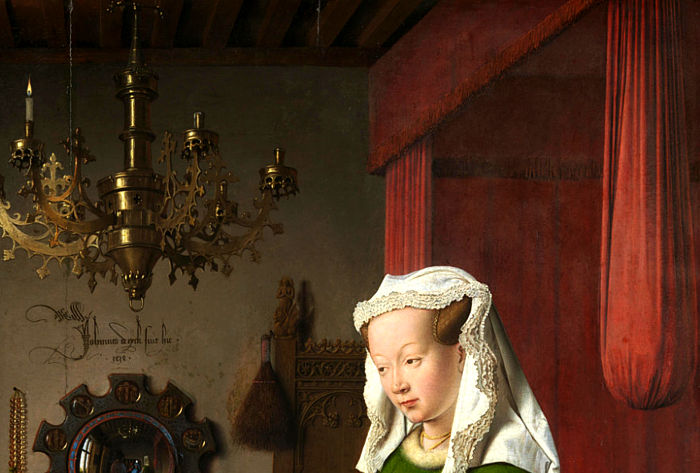
The bed with its crimson canopy dominates the right half of the painting. In well-off homes of the period, the bed could occupy the main reception room as a symbol of lineage, inheritance and hospitality.
The convex mirror and the signature: the all-seeing eye
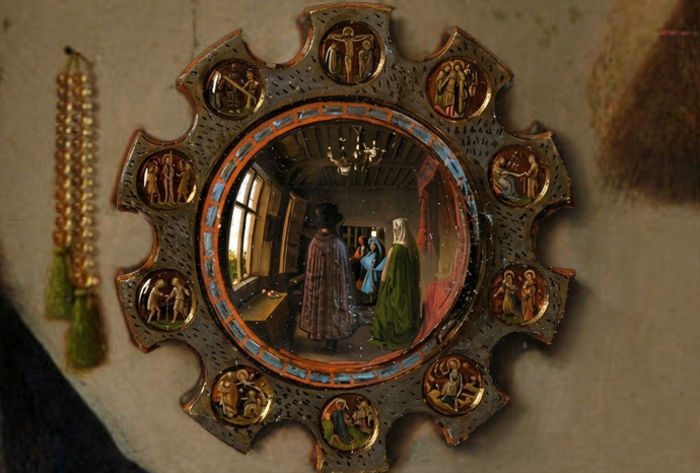
If one element sums up the genius of the painting, it is the round mirror at the back. Its frame is decorated with ten tiny medallions depicting scenes from the Passion of Christ. The mirror reflects not only the backs of the two figures but the rest of the room: the entrance door and two figures dressed in blue and red who are entering the room.
One of those figures is usually identified as Jan van Eyck himself. Just above the mirror, the artist wrote an inscription in Latin in Gothic script:
Johannes de eyck fuit hic / 1434
("Jan van Eyck was here / 1434")
The phrase does not use the usual formula of authorship (me fecit, "made me"), but a testimony of presence: "was here." The painter places himself as an eyewitness to what is taking place.
Looking into the mirror, we discover that the viewer stands at the vantage point of those who are crossing the threshold. Van Eyck shortens the distance between painting and reality and draws us into the room.
The lamp and the lone candle
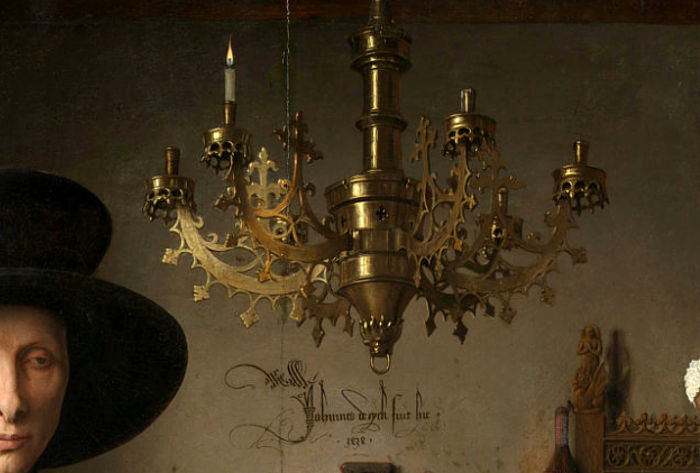
On the brass chandelier hanging from the ceiling there is an intriguing detail: of all its arms, only one candle is lit, on the man's side. Interpretations are divided:
- The marital reading: the single candle alludes to the presence of God, who sees all and blesses the union.
- The elegiac reading: if the painting depicted a deceased wife, the lit candle would symbolize life that goes on, and the absence of a candle, life that has been extinguished. This is a hypothesis, not a conclusion accepted by everyone.
Saint Margaret and the little broom
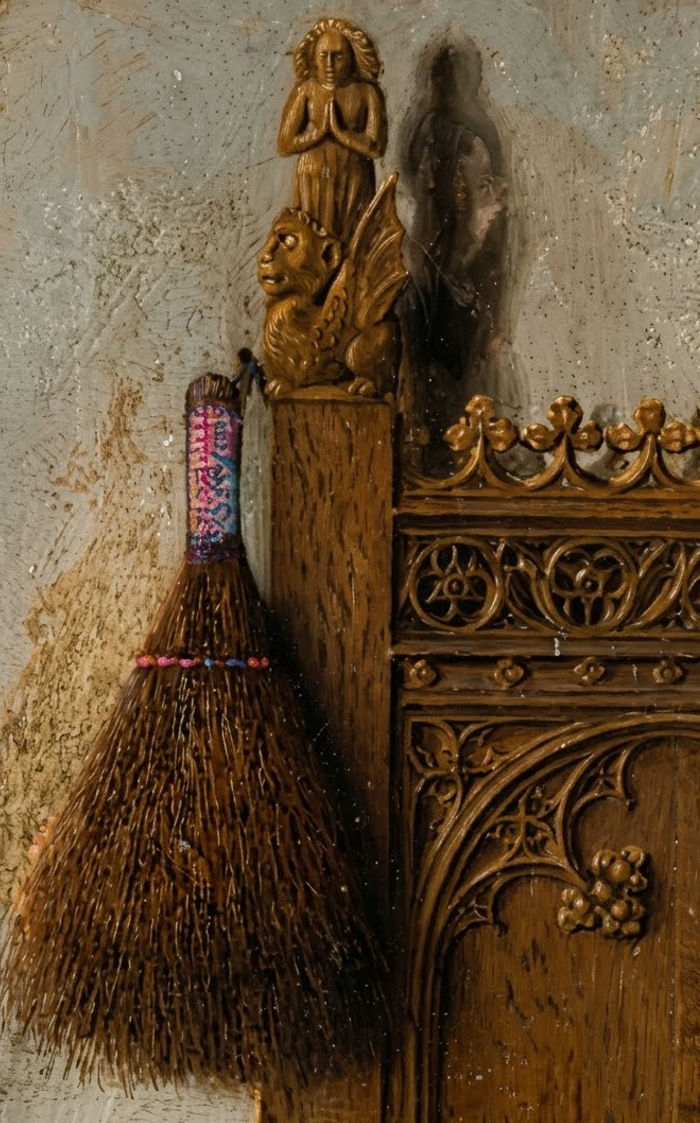
On the finial of the chair beside the bed, a small carved figure of Saint Margaret of Antioch appears. According to legend, she emerged unharmed from the belly of a dragon that had swallowed her, which is why she was invoked as the protector of women in childbirth. Her presence in a marital bedroom is usually read as an allusion to motherhood and the risks of childbirth, although there is no agreement on whether it points to a wish for children or to a loss. Nearby, hanging on the wall beside the bed, is a small brush or hand broom. It is commonly interpreted as a symbol of the care of the home and the domestic diligence expected of the wife, although no document from the period confirms that meaning. Between the saint and the little broom, the scene brings together two facets of married life: the uncertain fate of motherhood and the daily order of the household.
The power of an inexhaustible enigma
Almost six centuries after Van Eyck's pigments settled on the oak panel, The Arnolfini Portrait continues to inspire admiration and debate. It is a painting that does not give up all its answers: every detail examined raises new questions about devotion, social pride, love and memory at the dawn of the modern world.
Jan van Eyck was not content to record a face or a space; he created a visual labyrinth of extraordinary subtlety. By writing on the wall that he "was here," he not only left proof of his time in Bruges in 1434: he ensured that we, centuries later, would keep looking in through that same door, trying to decipher the mystery.
THE ARTWORK
The Arnolfini Portrait
Jan van Eyck
The Netherlands, 1434
Technique: Oil (82 × 60 cm)
Museum: National Gallery, London (United Kingdom)