

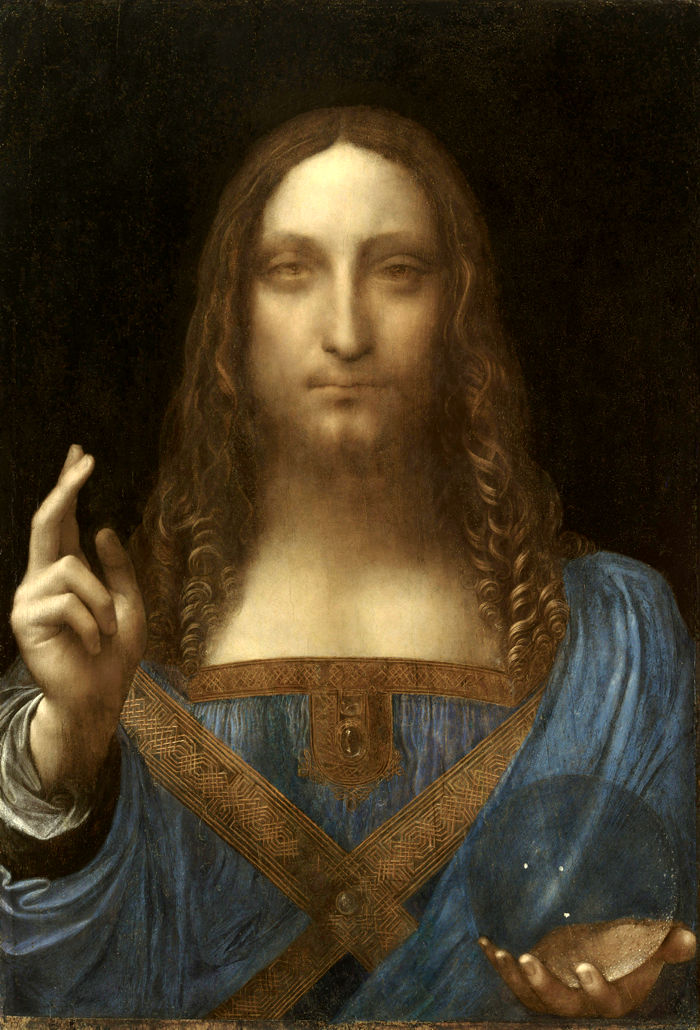
This is Christ holding a crystal sphere that seems to defy the laws of physics. It is called Salvator Mundi, the “Savior of the World.” At first glance it is a serene, almost hypnotic image, but a few minutes of observation are enough to discover that every detail hides an intention: the sphere, the hand, the face, the blue of the robe, the empty background. This painting does not merely show a sacred figure; it poses a riddle that continues to fascinate those who look at it closely.
A Composition Rooted in an Ancient Tradition
The composition of the Salvator Mundi is born of an ancient tradition: Christ facing forward, his right hand raised in blessing and a globe in the other. It is a formula designed for devotion. The frontal, symmetrical, solemn figure addresses the person contemplating the image directly, as if the gaze were a silent dialogue between the faithful and the divine.
Within that tradition, the element that draws the most attention is the globe. For centuries, that sphere represented earthly power: an opaque ball of metal or stone, topped by a cross, similar to the ones carried by kings. It was the symbol of whoever ruled the material world. But here there is no cross. And the sphere is completely transparent.
From Power over the Earth to Dominion over the Cosmos
That change is no mere decoration. In the cosmic symbolism of the Renaissance, it was believed that the stars and the universe were contained in a gigantic transparent sphere surrounding the Earth. According to the cosmology inherited from antiquity, the sky was not an infinite void but a set of concentric crystalline spheres that revolved around our planet and carried the celestial bodies with them. Whoever looked at the sky was actually looking at the inside of those spheres.
By replacing the opaque stone with crystal, the painting stops representing dominion over the Earth and becomes control over the entire cosmos. The ball that kings hold is a small world in their hands; the sphere that Christ holds is the entire universe, visible and luminous. He is not only the Savior of the World: he is the Savior of the Universe.
The Great Visual Puzzle: A Sphere That Does Not Distort
But here begins the great visual puzzle. A solid glass ball acts as a lens: it inverts the light and drastically distorts everything behind it. Anyone who has looked through a glass sphere knows this: the landscape appears small, inverted and twisted. Yet if you look through the sphere in this painting, the folds of the robe look practically intact, clean and straight. Only the palm of the hand pressing against the base of the crystal appears slightly flattened and lightened, a detail that does respect what would happen in reality.
Why would the artist, an absolute master of optics and physics, make such a basic “mistake”? It is not a minor oversight: the painter had devoted a good part of his life to studying how light behaves, how it is reflected and how the human eye focuses. That is why many observers doubt it is a simple flaw. There are three fascinating answers hidden in the painting.
The first is theological: distorting the figure of Christ would have been grotesque in a devotional icon. An inverted, warped robe inside the sphere would have broken the solemnity of the image and distracted the viewer from what is essential. By breaking the laws of physics, the painting gives him a superhuman, miraculous presence: the divine does not obey the rules of matter.
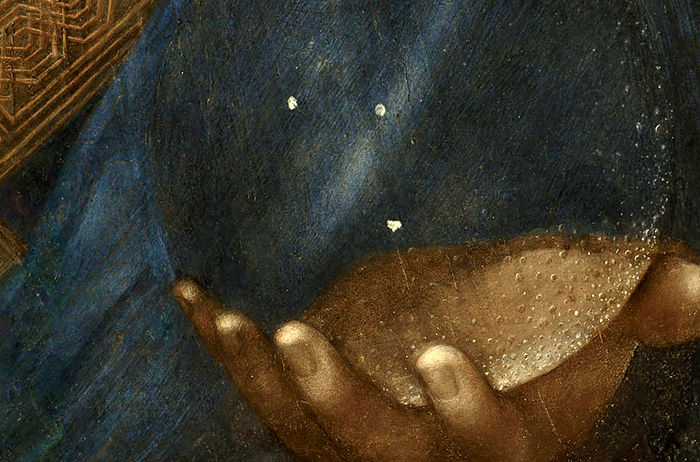
The second is physical: if the sphere were completely hollow and made of extremely thin glass, light would pass through it with almost no distortion of the image. A thin glass bubble does not work like a solid lens; it acts more like a transparent membrane. Under this reading, the painter would have made no mistake at all, but would have accurately depicted an object different from the one we believe we see.
The third is hidden inside: within the crystal there are small bright specks painted with absolute delicacy. They are not ordinary bubbles. They represent the natural inclusions of rock crystal, a sacred mineral associated with purity. They are the tiny imperfections that nature leaves in quartz, reproduced with almost scientific precision.
But look at them closely and three of those specks form a precise alignment. It is a miniature star map: a representation of the celestial bodies floating in Christ's hand. Thus the interior of the sphere stops being an empty space and becomes a small sky held in the divine palm.
The Hand That Blesses and Breaks the Frame
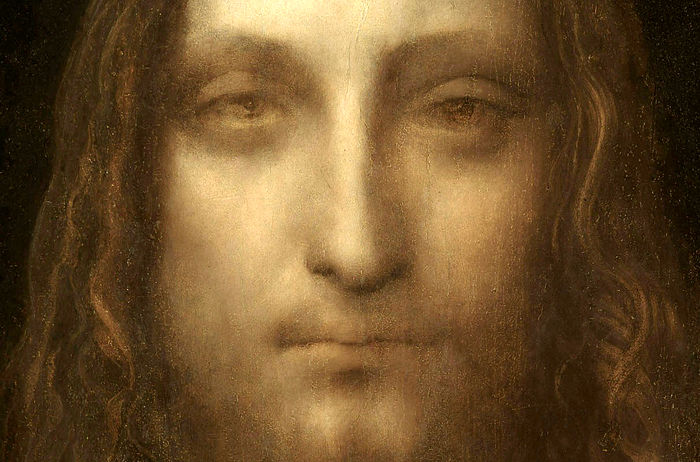
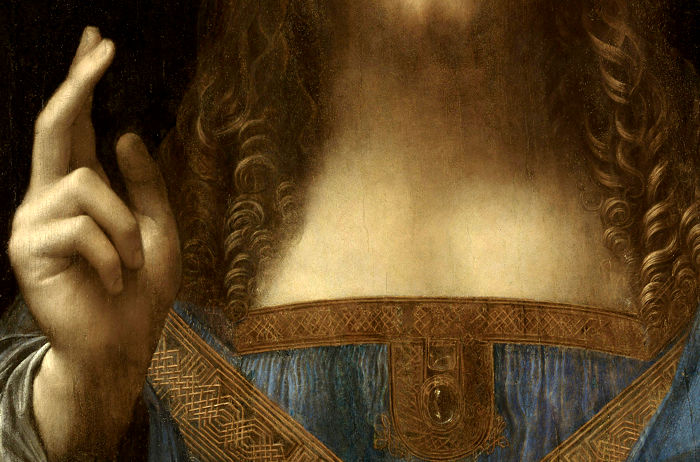
Let us turn to the blessing hand. Notice how the hand is perfectly defined, with sharp, detailed strokes, while the face right behind it looks soft, blurred and mysterious. The difference in sharpness is deliberate and highly effective.
This reproduces exactly how the human eye works: when you focus on what is near, what is far loses sharpness. Try it with your own hand in front of a face: if you focus on your fingers, the face blurs. In doing so, the hand seems to break the surface of the canvas and reach straight out toward the viewer, as if the blessing were not painted but happening at that very moment.
The Thumb That Changed Position
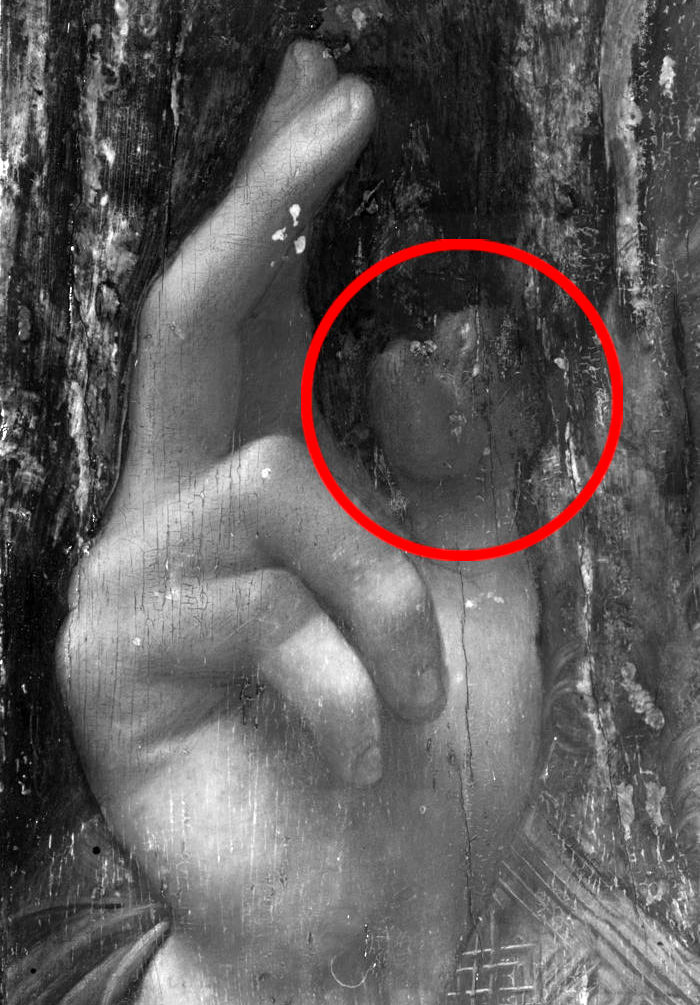
If we look beneath the painting with infrared photography, we discover something striking: the thumb of that hand was originally in a different position. The technical studies carried out during the restoration of the work made it possible to see that first version, which remained hidden under the final layers of paint.
The artist changed his mind while painting, correcting the anatomy to give it a unique three-dimensional volume. Every correction of this kind is a small window into the creative process: the work did not emerge from a ready-made formula, but from a constant search. It is the living trace of a mind creating in real time.
Sfumato: A Mystical Haze Over the Face
The face displays the sfumato technique, that mystical haze in which shadows and light blend without any perceptible lines or edges. The word comes from the Italian sfumare, “to fade like smoke,” and it describes the effect exactly: contours are not drawn, they dissolve.
This technique is applied in layers so thin that the pigment seems to have melted directly under the fingertips. The result is a face that cannot be pinned down: the gaze seems to change with the angle, and the expression hovers between serenity and a slight melancholy. That mystery is an essential part of its devotional power.
The Curls of Hair and the Swirls of Water
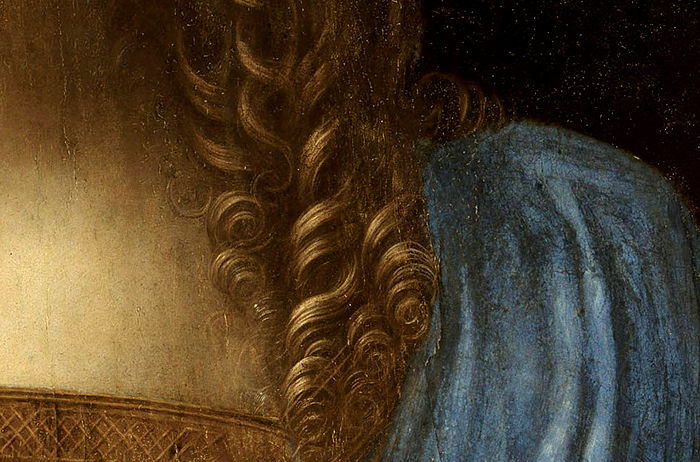
Now look at the curls of the hair. They are not ordinary ringlets. They fall and twist, imitating the exact behavior of water swirling in a fast current. Notice how the locks coil, separate and join again, just as water does when it strikes an obstacle.
For the mind that designed this, nature is one, and the patterns of water are reflected in the human body. It is an idea very typical of Renaissance thought, which saw a deep correspondence between the great order of the universe and the small order of the human being. The same movement that governs a torrent quietly governs a lock of hair.
Renaissance Garments and Ultramarine Blue
Christ does not wear the clothing of his historical era, but Renaissance garments. It is a decision full of meaning: it brings the sacred figure closer to the viewer's world and presents him as a contemporary presence, not a distant memory.
The chosen color is ultramarine blue, made from powdered lapis lazuli, the most expensive and prized pigment in history. Its name means “beyond the sea,” because the stone was brought from distant lands, and its cost came to exceed that of gold. Dressing Christ in this blue was a declaration of reverence: only the most valuable could clothe the most sacred.
The Stole and the Endless Knots
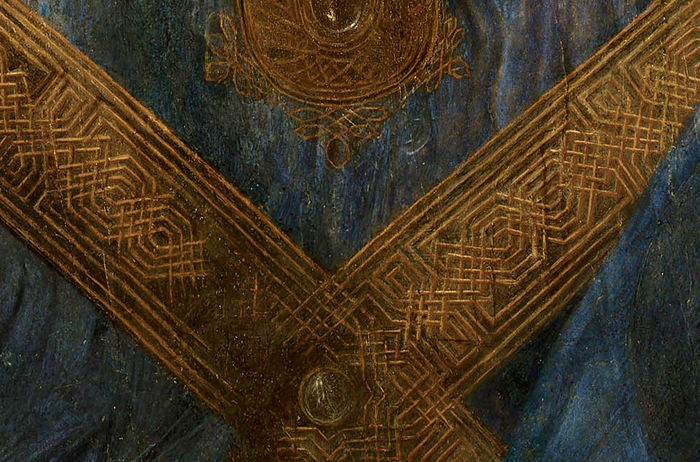
On the chest, the stole is decorated with patterns of interlaced endless knots. They symbolize eternity, the divine without beginning or end. They are lines that cross and intertwine so that you cannot point to where they start or where they finish, a visual image of infinity.
It is a hypnotic geometric design that also appears hidden in other masterpieces of the period. Its presence here is no accident: it repeats, in miniature, the same idea that the sphere expresses on a grand scale. The eternal and the cosmic converse in every corner of the painting.
A Gaze That Crosses the Screen
And behind him... nothing. No landscapes, no windows, no angels, no distractions. Only a dark background and a direct gaze that crosses the screen. That absence is a radical decision: by removing everything anecdotal, the image concentrates attention on three essential elements, the face, the hand and the sphere.
The emptiness turns the figure into an icon, a presence without time or place that addresses each viewer personally. There is no setting to interpret; only a direct encounter between the one who looks and the one who is looked at.
Today the whereabouts of this painting are an absolute mystery, but that does not matter. The mystery remains intact. Wherever it may be, the message of the Savior of the World remains suspended in that crystal sphere: an entire universe held in the palm of a hand, waiting for someone to look at it with enough attention to discover it.
THE ARTWORK
Salvator Mundi (Christ as Savior of the World)
Year 1500
Author Leonardo da Vinci
Technique Oil on walnut
Size 45.4 × 65.6 cm
Location Unknown