

Venus had no mother. She was born of the sea, from the foam that formed when Cronus threw the remains of his father Uranus into the ocean. From that mixture of water, foam, and divinity, Aphrodite emerged — the goddess the Romans would later call Venus. Sandro Botticelli chose to paint exactly that instant: the moment a newborn goddess first sets foot in the world of men.
A Myth with Several Classical Sources
The subject of this celebrated painting is drawn from Ovid's Metamorphoses, although the story of Venus's birth also appears in Hesiod's Theogony and in a Homeric hymn dedicated to the goddess. Botticelli, like much of the artistic and intellectual community of fifteenth-century Florence, drew directly on these Greco-Roman sources, which humanists of the time recovered and reinterpreted with great enthusiasm.
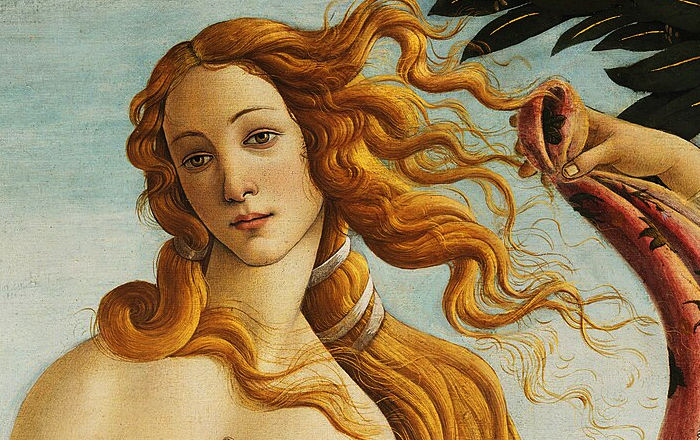
A note on the title: the name The Birth of Venus, as with other Renaissance works, was only adopted in the nineteenth century. Despite the title, the scene does not literally depict a birth, but rather the goddess's landing on the island of Cyprus, already fully formed and adult, having just emerged from the waters.
The Scene: A Landing, Not a Conquest
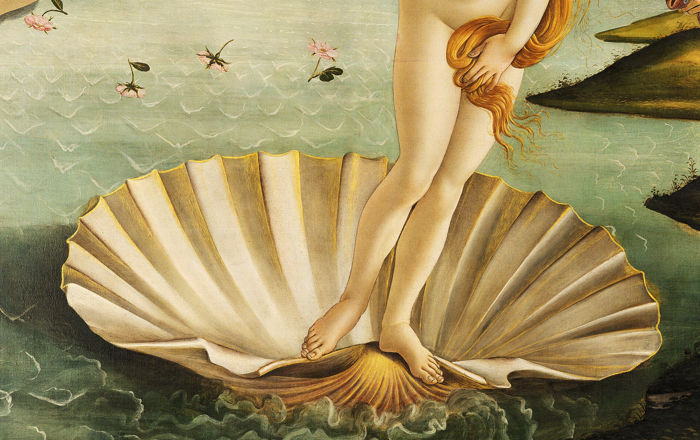
At the center of the composition, Venus stands on an enormous shell, moving toward the shore with a lightness that seems to defy the weight of her own body. She does not arrive like a conqueror or with a triumphant gesture; there is something hesitant, almost shy, about her posture, as if she were arriving in a world she does not yet know. The sea behind her is barely suggested, treated almost like a flat, two-dimensional backdrop, with the waves rendered through simple linear marks that deliberately break with any attempt at realistic depth.
Zephyr and Chloris: The Wind That Carries the Goddess
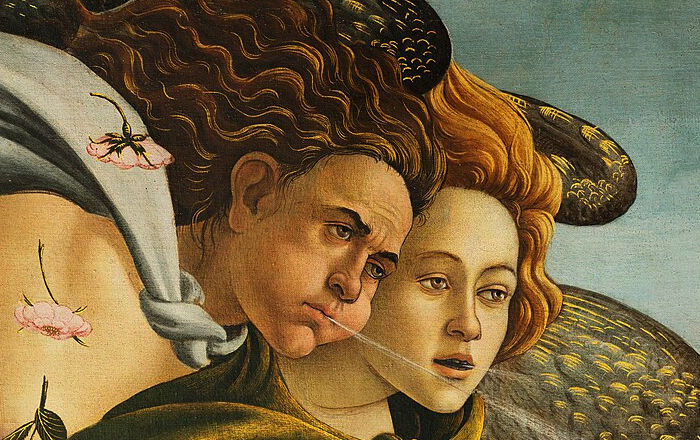
On the left side of the painting, two intertwined figures blow toward Venus, gently pushing her toward the shore. This is Zephyr, the personification of the west wind, embracing the nymph Chloris as the two of them propel the goddess toward dry land. This winged pair is believed to derive from a very specific classical source: the decoration on a Hellenistic gem that belonged to Lorenzo the Magnificent, Botticelli's patron and a central figure of Medici Florence.
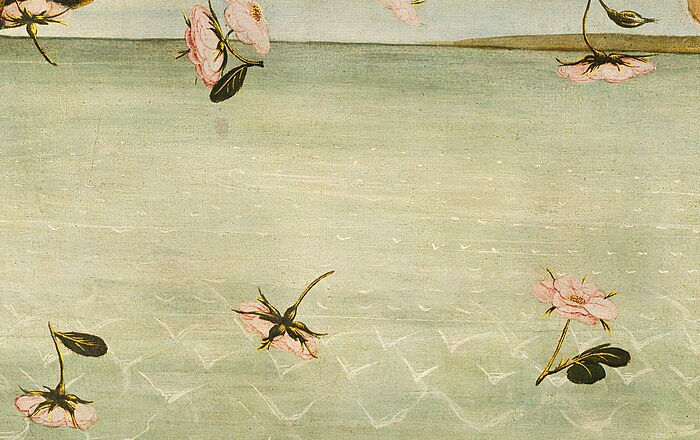
Small roses fall around the scene, a detail that often goes unnoticed but is far from incidental. In mythological tradition, the rose was closely tied to Venus: its beauty and fragrance stood for love and pleasure, while its thorns hinted at the danger that desire could also bring. In fact, Venus is the root of a word still used today in medical language: venereal, from the Latin venerius, a term that came to be associated with everything related to desire, sexuality, and physical love.
The Gesture of Modesty and the Venus Pudica Model
Venus is nude, covering her pubis with one hand in a gesture of reserve that was not Botticelli's invention. That gesture reproduces the pose found in ancient classical sculptures known as the Venus Pudica, an iconographic type that takes its very name from that modest, restrained gesture. Botticelli was consciously reviving an image that belonged to Antiquity and transplanting it into Quattrocento Florence.
The goddess's long hair serves a similar function: it partially covers her body like a natural sheet, while at the same time forming a kind of frame around the whole figure. Every strand seems drawn specifically to follow the movement of the wind, in a series of rhythmic, flowing curves that repeat in the draping of the cloak and in the waves of the sea.
There is also something striking about the proportions of the body: on closer inspection, Venus is not built like a real woman. Her neck is too long, her shoulders sit in an unnatural position, and her torso stretches further than human anatomy would allow. Far from being a mistake, this distortion is entirely deliberate: Botticelli was not after anatomical realism, but an ideal beauty — a figure that seemed to belong more to the realm of poetry than to the direct observation of the human body.
The Hora's Cloak and the Language of Flowers
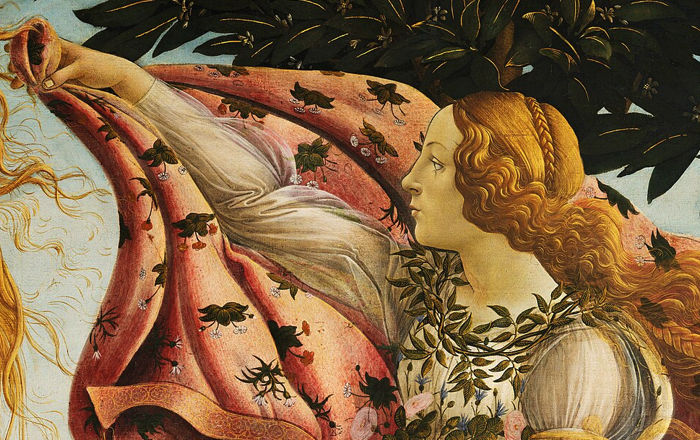
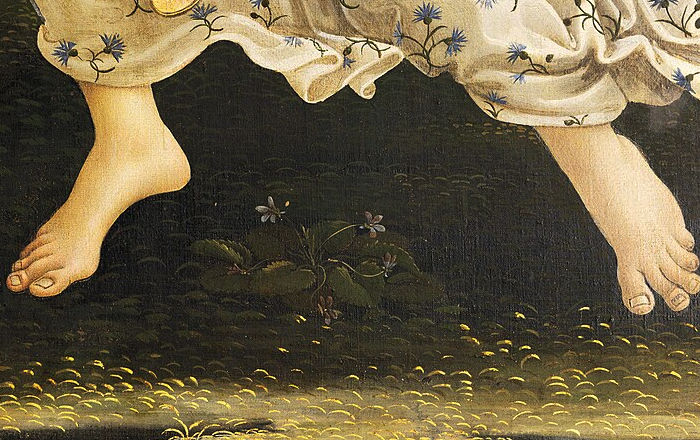
On the right side of the composition, one of the Horae — deities associated with the seasons — waits on the shore to cover Venus as soon as she reaches land. She offers her a cloak embroidered with myrtle, primroses, and roses, a piece that stands as a masterpiece in its own right, rendered with a level of floral detail comparable to a painted garden. Among the flowers on her gown are also daisies and violets, species traditionally linked to spring and fertility.
Nothing in the scene seems to be there by chance: the sea, the wind, the flowers, the nude body, the birth, and love all speak the same symbolic language, coherent from beginning to end.
Neoplatonism: Beauty as a Spiritual Force
As with The Primavera, another of Botticelli's masterpieces, The Birth of Venus was born within the Neoplatonic culture that dominated Florence's intellectual circles at the time. The court of Lorenzo the Magnificent was home to numerous thinkers who followed this philosophical current, which understood love as a vital principle and as a force capable of renewing nature.
Under this reading, Venus is not simply a beautiful woman: she is the personification of beauty itself. Her nakedness is not meant to display a body, but to represent something not yet corrupted, an original purity. The underlying theme of the painting would then be the celebration of the birth of a new humanity, mediating between physical passion and spiritual elevation. The message becomes a search for balance between earthly passions and something higher — an ideal very much at the heart of Renaissance thought.
Simonetta Vespucci: The Face of the Goddess?
As with other works by the artist, it has long been suggested that Venus's face may have been inspired by Simonetta Cattaneo Vespucci, a noble Genoese lady said to have been Botticelli's lasting muse and platonic love. This is a widely repeated hypothesis within the tradition surrounding the painter, though it should be treated with some caution: there is no contemporary documentary source that conclusively confirms Botticelli deliberately depicted Simonetta's features in this particular work, beyond a stylistic resemblance to other portraits attributed to her.
A Painting Without an Explanation
Botticelli likely painted this work in the 1480s, in a Florence fascinated by classical Antiquity. Artists studied Greco-Roman sculptures and texts while humanists recovered stories that had remained on the margins of European culture for centuries. The painting was connected to the Medici circle, one of the most powerful families in the city.
And here lies one of the most interesting questions: we do not know with absolute certainty what this work meant to whoever commissioned it. We know it contains symbols, classical references, and a very particular idea of beauty, but Botticelli left no explanation that would allow us to fully decode it.
Perhaps that is why we keep looking at it: the more we learn about its details, the more questions arise. Are we simply looking at the birth of a goddess? Is it an allegory of beauty? Does it speak of love, of spring, of the transformation of nature? Perhaps it is all of these things at once.
And perhaps that is the reason this image has survived for more than 500 years: Venus keeps arriving, the wind still moves her hair, the roses still fall around her, and that girl born from the sea foam continues, slowly, to step into our world.
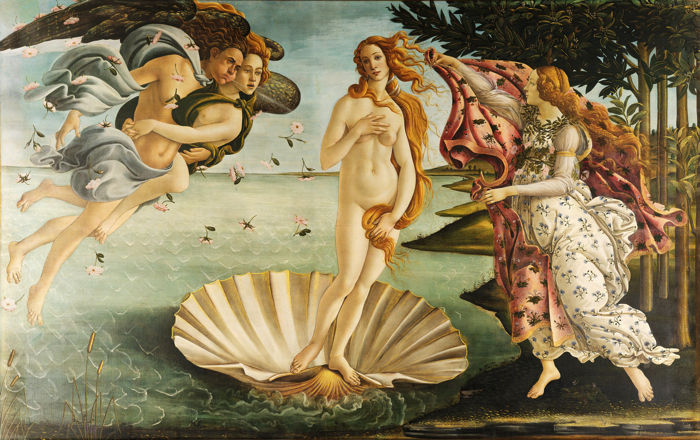
THE ARTWORK
Sandro Botticelli
The Birth of Venus
Dated between 1476 and 1487
Tempera on canvas
172.5 x 278.5 cm
Florence, Uffizi Gallery