

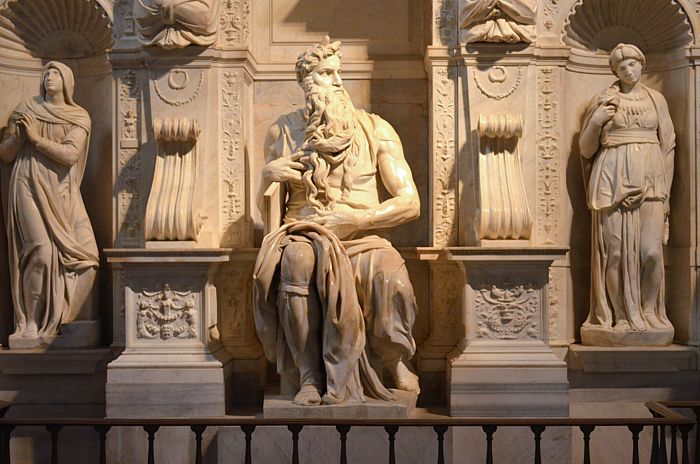
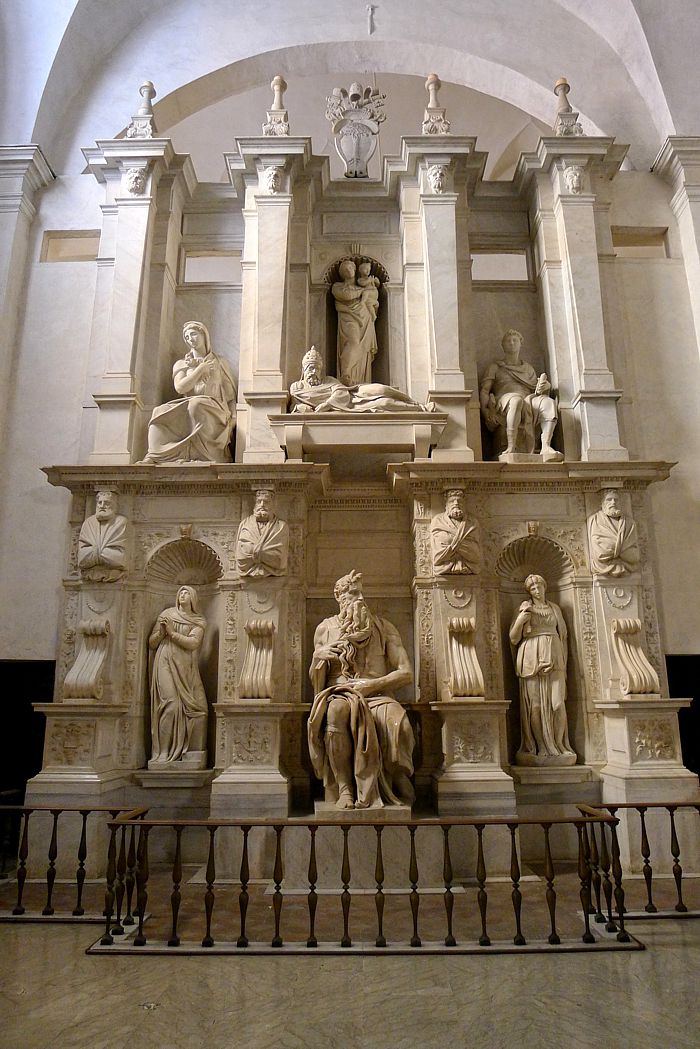
You walk into a church in Rome that almost nobody puts on their list of places to visit. It has neither the grandeur of St. Peter's nor the endless lines of the Colosseum. It is San Pietro in Vincoli, a quiet basilica of ancient columns and warm light. You stroll down the nave expecting nothing in particular, and then you see it. At the far end, seated above a tomb, an old man made of marble holds your gaze. And it is not a friendly look.
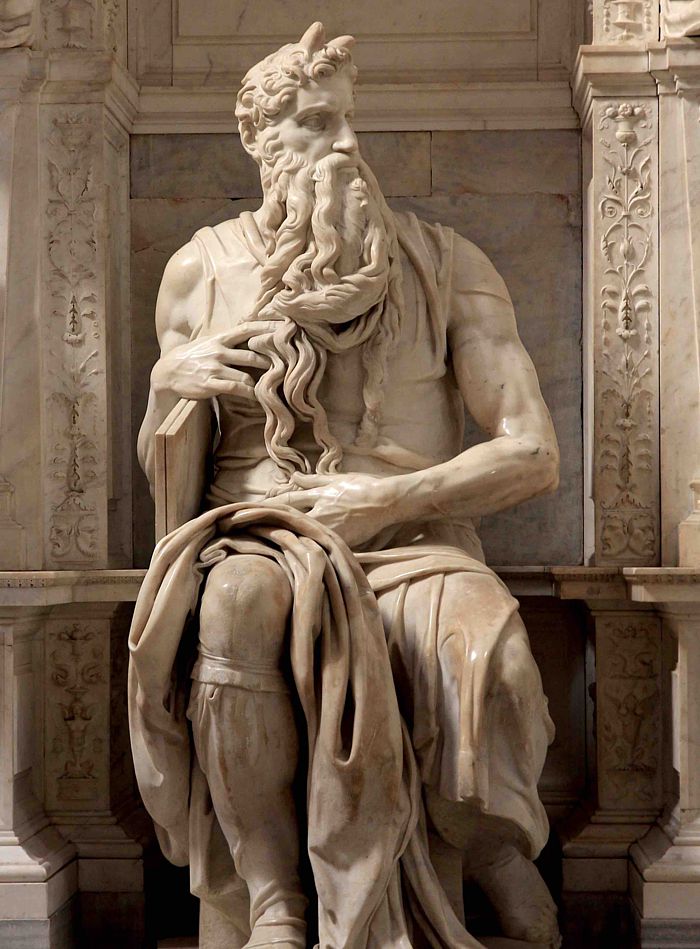
It is Michelangelo's Moses, carved around 1513 to 1515, a figure more than two meters tall that has spent more than five centuries on the verge of doing something nobody can say for certain. It has a beard that falls like a petrified waterfall, stone tablets under one arm and a brow that seems to hold back a storm. And if you step close enough, you notice a detail that unsettles: two small horns peek out from its hair.
They are neither a whim of the sculptor nor a slip of the chisel. Behind those horns lie a Hebrew word that allowed two readings, a translator who chose one of them, a pope of boundless ambition, and a legend according to which the artist himself, standing before his work, could not help speaking to it.
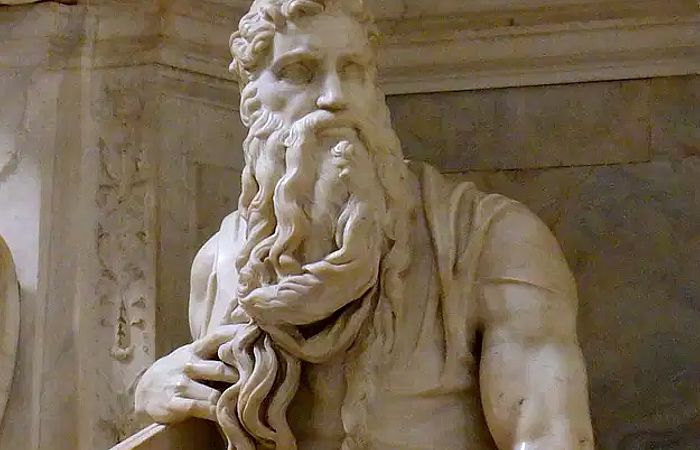
The Second Before the Outburst
In the Book of Exodus, Moses spends forty days on top of Mount Sinai. There he receives the tablets of the Law and comes down carrying them, convinced he is bringing his people the greatest promise anyone has ever received. But when he reaches the valley he hears music, laughter and shouting. Below, the very men and women he has just led out of Egypt are dancing around a golden calf. The text says that Moses' anger burned hot, and that he threw the tablets to the ground until they broke.
Any less daring sculptor would have carved that outburst: the arm raised, the tablets in midair, the mouth open in a cry. Michelangelo chose something more unsettling. He chose the second before.
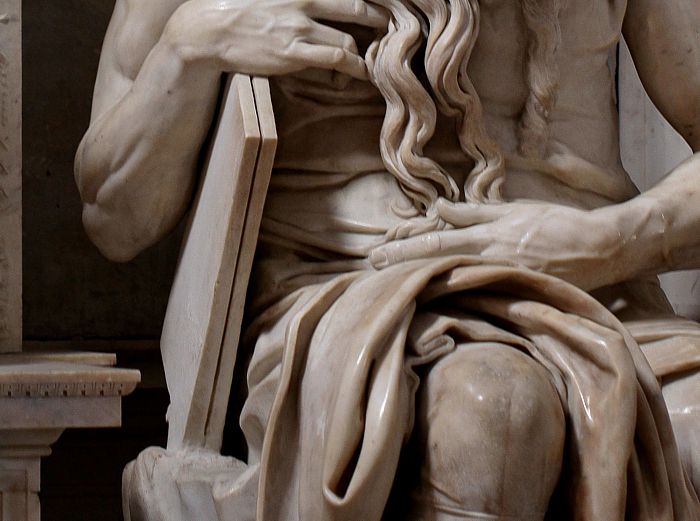
Look at the body. Moses is seated, but he is not at rest. His right leg is planted firmly on the ground while the left is drawn back and barely touches the stone with the tip of the foot, like a runner just before the start. The head turns sharply to one side and the eyes lock onto something we cannot see: perhaps the calf, perhaps the entire people, perhaps his own fate. One arm presses the tablets against his side, and between the hand and the beard a tension runs through the marble. The tablets remain intact. The fury has not yet burst, but it is there, throbbing beneath the skin of stone.
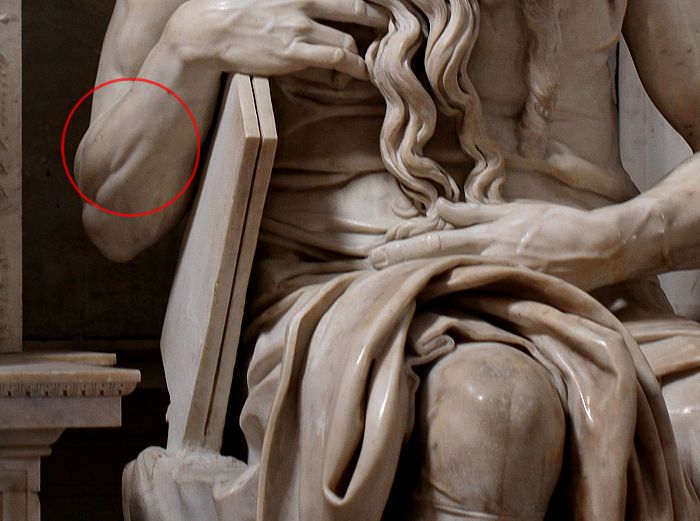
The arms show prominent veins and tendons taut as cords, the body of someone who has spent years carrying a people on his shoulders. It is often explained that the sculpture was designed to be seen from below, on an upper level of the original tomb, which would help explain certain proportions, such as the size of the head and the arms. The artist's contemporaries had a word for that quality that commanded respect and also a little fear: terribilità. Few works embody it as well as this one.
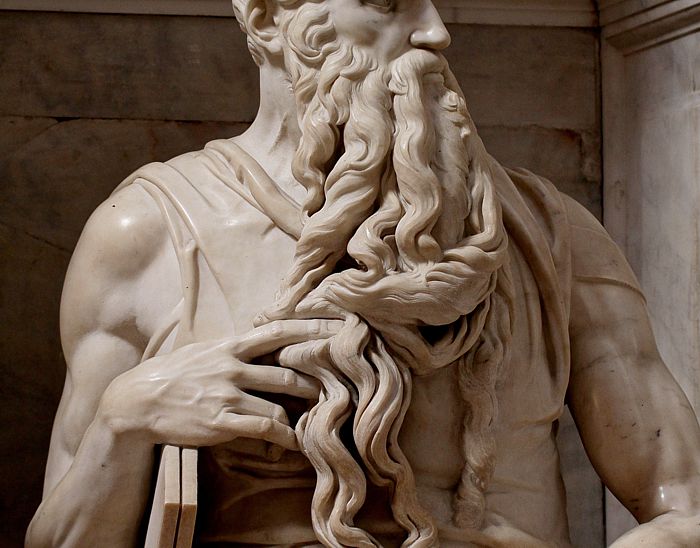
The Word That Gave a Prophet Horns
Now, the horns. To understand them we must travel back to the end of the fourth century, to the city of Bethlehem, where Saint Jerome had set himself a monumental task: translating the Bible into Latin. His version, known as the Vulgate, would become the reference text for the whole of the West for more than a thousand years.
In chapter 34 of Exodus, the text says that Moses comes down from the mountain after speaking with God and that his face radiates something extraordinary, so much so that people dare not approach. The problem lies in the Hebrew verb describing that radiance. It is a verb related to the word meaning "horn." It can be understood as emitting rays, as shining, or as having horns. It is a genuine ambiguity of the language, the kind that a dictionary cannot settle.
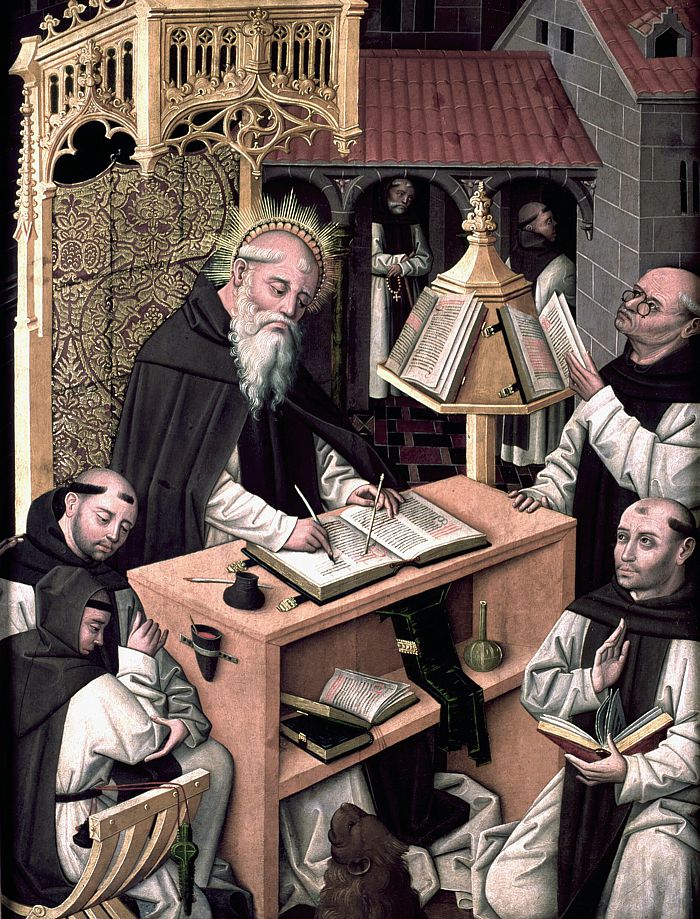
Jerome leaned toward the literal reading and wrote that Moses' face was horned. There was no ill will or mockery, and not necessarily ignorance either. Today scholars debate whether it was a mistake or a possible choice given an ambiguous text. What is certain is that this decision set a tradition in motion. For centuries, manuscript illuminators, painters and sculptors portrayed Moses with horns, simply because that was the Bible they held in their hands.
Michelangelo knew that tradition and respected it, but in his own way. He did not carve prominent horns, but two small, discreet protrusions, almost hidden among the curls of his hair. They look less like horns than like sparks, two flashes of light that the sculptor had to turn into stone because stone was his only language.
The Visitor Who Could Not Leave
If the statue already intrigued the artist's contemporaries, in the early twentieth century it captivated an unexpected visitor. Sigmund Freud, the father of psychoanalysis, visited San Pietro in Vincoli again and again and spent hours before the Moses, studying it from different angles. In 1914 he devoted an essay to it, which he first published unsigned, like someone unsure whether he should confess an obsession.
His conclusion ran against the most popular reading. For Freud, Moses is not about to rise and smash the tablets. He has already felt the surge of rage and is overcoming it. The tablets, which seem about to slip, stay in place because he restrains himself. What the sculpture would capture, then, is not a prophet blinded by anger, but something much harder: a man who masters the storm within him.
Other specialists see exactly the opposite, a Moses about to stand up or startled by a sudden noise. None of the readings has definitive proof, and perhaps there lies much of the work's power. Michelangelo did not close the scene. He left it hanging in the air, and for centuries it has kept us in doubt.
A Pope, a Tomb and a Dream That Shrank
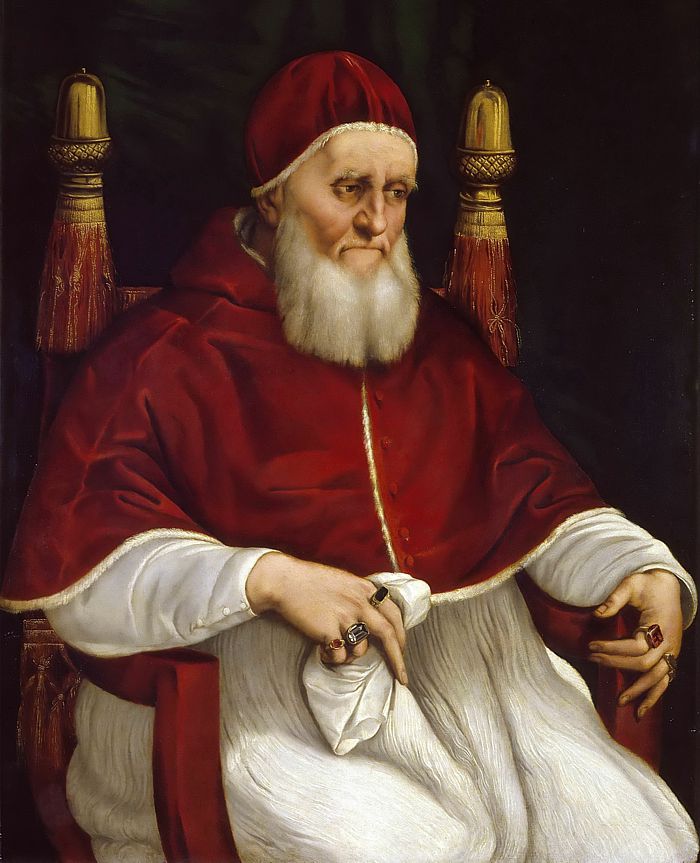
This formidable figure was never meant for a modest church. It was born tied to the ego of a formidable and dangerous man: Pope Julius II, known as the Warrior Pope because he did not merely bless armies but put on armor and led military campaigns.
In 1505, Julius II commissioned his own tomb from a young sculptor of thirty. He did not want an ordinary burial place. He imagined a gigantic monument, with dozens of marble statues, that would make clear forever who he had been. Michelangelo accepted, fascinated, and spent months in the quarries of Carrara, choosing with his own eyes the blocks that in his mind were already figures.
But popes change their priorities. Julius II began to direct his money toward rebuilding St. Peter's Basilica and ended up pushing the sculptor, who protested along the way, to paint the ceiling of the Sistine Chapel between 1508 and 1512. When the pontiff died in 1513, the dream was already wounded. The heirs signed one contract after another, each version more modest than the last. His biographer Ascanio Condivi would call that endless commission "the tragedy of the tomb."
The final monument was completed in 1545, much smaller than planned, and installed in San Pietro in Vincoli, the church of which Julius II had been cardinal before becoming pope. Of that gigantic dream, a reduced version survived, but at its center stands the Moses, with all its force intact.
Many have wanted to see more than a coincidence there. A prophet who guides his people, who gives the laws and bows to no one could be read as a reflection of the pope who commissioned the work, a feared leader who could not conceive of surrender. It is an interpretation, not a documented fact. But it fits the man so well that it is hard to shake from your mind.
The Stone That Almost Answers
Around truly extraordinary works, stories always sprout. Giorgio Vasari, the great biographer of Renaissance artists, tells that the Jews of Rome would gather in groups on Saturdays to visit the sculpture, while Michelangelo was still alive. It is a revealing detail of the impact it made from the start.
More famous is another anecdote, the one repeated by guides and travel books. They say that, on finishing the work, Michelangelo was so struck by how alive the Moses looked that he struck the statue's knee with his hammer and shouted: "Why don't you speak?" No document from the period confirms it, and it is most likely a later invention. But it is still told for a very simple reason: because anyone who stands before that gaze today feels exactly the same. That the stone is about to draw breath, that the back muscles are about to tense and that, at any moment, the old man will rise to his feet.
And there it remains, more than five centuries later. Seated on its marble throne, with the tablets intact under its arm, with the horns of a word that was translated a step too far, and with its eyes fixed on a golden calf that we never get to see. A man about to decide what to do with his fury, who has gone more than five hundred years without deciding.
ARTWORK
Moses
Michelangelo Buonarroti (1475-1564)
Date: c. 1513-1515
Medium: marble sculpture
Dimensions: approx. 235 cm (about 7.7 ft) tall
Style: High Renaissance
Location: Basilica of San Pietro in Vincoli, Rome (Italy)