

The hunger for love can become dangerous, as Deianira found out. She was the wife of Heracles (Hercules to his friends) and, by mistake, his executioner. Her obsessive and toxic love would cause the death of the very man she so desperately wanted. Deianira was the daughter of King Oeneus of Calydon, and she was so beautiful that suitors fought over her. One of them was none other than Achelous, a river god who could turn himself into a bull or a serpent. Heracles challenged him, defeated him in a fierce fight and tore off one of his horns. That is how he won the bride, the way heroes won almost everything: with his fists.
Not long after, following an accident at a banquet in which he killed a young servant, Heracles chose to go into voluntary exile and set out with his wife. The road led them to the river Evenus, swollen and hard to cross.
Crossing the River
On the bank waited the centaur Nessus, who made his living carrying travelers from one side to the other. Heracles crossed on his own and asked Nessus to carry his wife. But halfway across, the centaur stopped being a ferryman and tried to assault Deianira. She screamed, and Heracles, from the far bank, shot an arrow straight into the centaur's chest. The tip was poisoned with the blood of the Lernaean Hydra, the very beast he had slain in one of the twelve labors we have already published on La Vida es Arte.
A Dying Man's Last Advice
Nessus, mortally wounded, knew that his revenge could come after his death. With his last breath he called Deianira over and gave her what seemed like generous advice: to collect his blood and keep it, because it had the power of a love potion. If she ever felt Heracles' heart drifting away, all she had to do was smear it on a piece of his clothing, and he would be completely hers, forever faithful, and his love would be eternal and good... All those things people promise in front of an altar.
Deianira, trusting, hid the blood and went on with her life. What she did not know was that the blood was mixed with the Hydra's poison, the same poison that had just killed the centaur. There is also a delicious irony: according to Sophocles, it had been prophesied that no living enemy could ever kill Heracles. Nobody said anything about the dead.
Iole
Years passed, and Heracles kept doing what he did best: conquering. In one of his campaigns he razed the city of Oechalia, whose king, Eurytus, had refused him the hand of his daughter Iole. Among the captives Heracles sent home was the young princess, and Deianira understood at once that she was no ordinary prisoner. That is where the fear was born, the insecurity of losing the hero she had waited for so many years. It was the moment Nessus had been waiting for since the river.
It was then that Deianira remembered the hidden vial. She spread the blood over a beautiful tunic, just as the centaur had told her, and handed it to her faithful messenger Lichas to take to Heracles, who was preparing to offer a sacrifice to Zeus on the island of Euboea.
Sophocles tells a chilling detail: a tuft of wool Deianira had used to rub on the blood fell into the sunlight and crumbled into dust, smoking. Only then did she understand that what she had kept was no love potion. But Lichas was already on his way.
The Tunic That Will Not Come Off
Lichas, unaware of his cruel fate, played the innocent errand boy and carrier of death, and just like the insecure lover, he added one more signature to Heracles' sentence. The hero put on the tunic for the sacrifice. But the heat of the fire awakened the poison, and he began to feel an immense pain and knew he was going to die. The tunic clung to his skin, and every attempt to tear it off took pieces of his flesh with it. Little by little, his body was consumed by the fire of the poison.
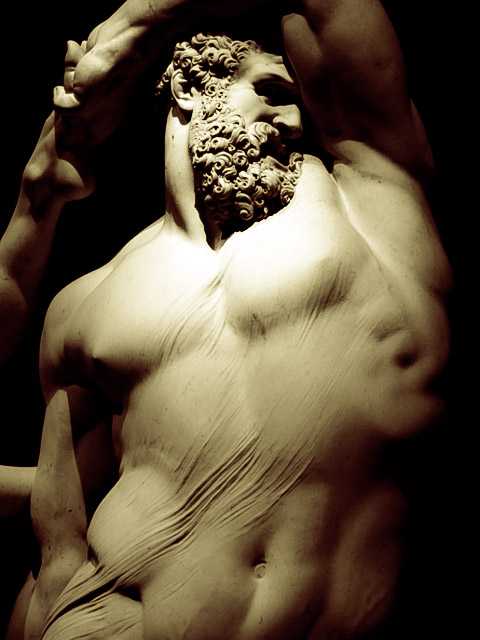
Heracles, maddened by pain and rage, seized Lichas by the feet in a fit of fury and hurled him into the sea. Then Lichas, who could not believe what was happening, surely coined in that moment of anguish the phrase: "Don't shoot the messenger". According to Ovid, as he fell into the water the young man's body hardened and turned to stone, and sailors can still see the rock in the sea off Euboea, in human shape.
The End of Deianira and the Pyre on Mount Oeta
When Deianira learned what she had done, she could not bear the guilt and took her own life. She died without ever having wanted to kill anyone: she only wanted to be loved.
Heracles, despite having drunk of Hera's milk and possessing Olympian powers, was not immortal in his body. Dying, he asked his son Hyllus to carry him to Mount Oeta and build a pyre. No one wanted to light the fire, until Philoctetes agreed to do it in exchange for the hero's bow and arrows. While the flames consumed everything mortal in him, Zeus welcomed him to Olympus. Hera, his old enemy, made peace with him and gave him her daughter Hebe as his wife. Thus, the man whom no monster could defeat died because of a tunic, but only after dying did he finally become a god.
Canova and the Instant Before the Fall
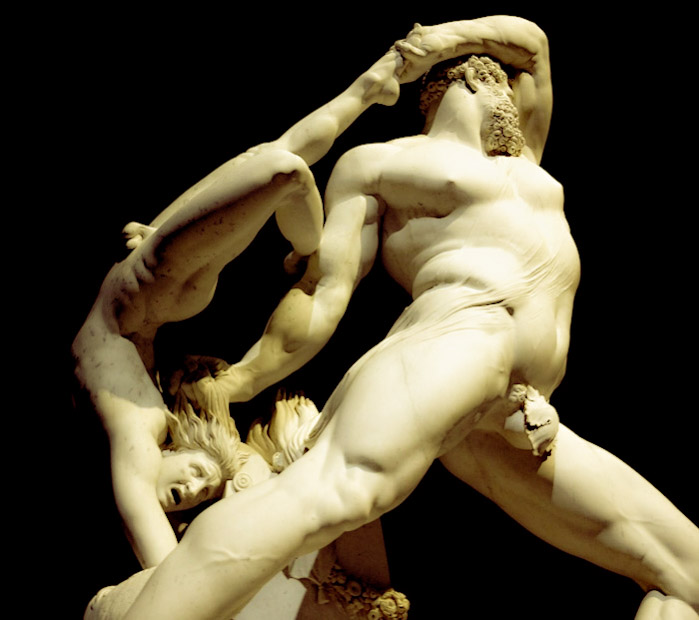
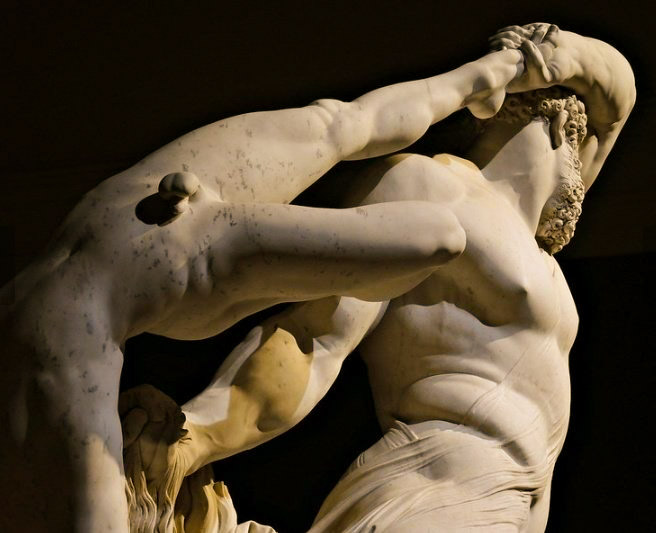
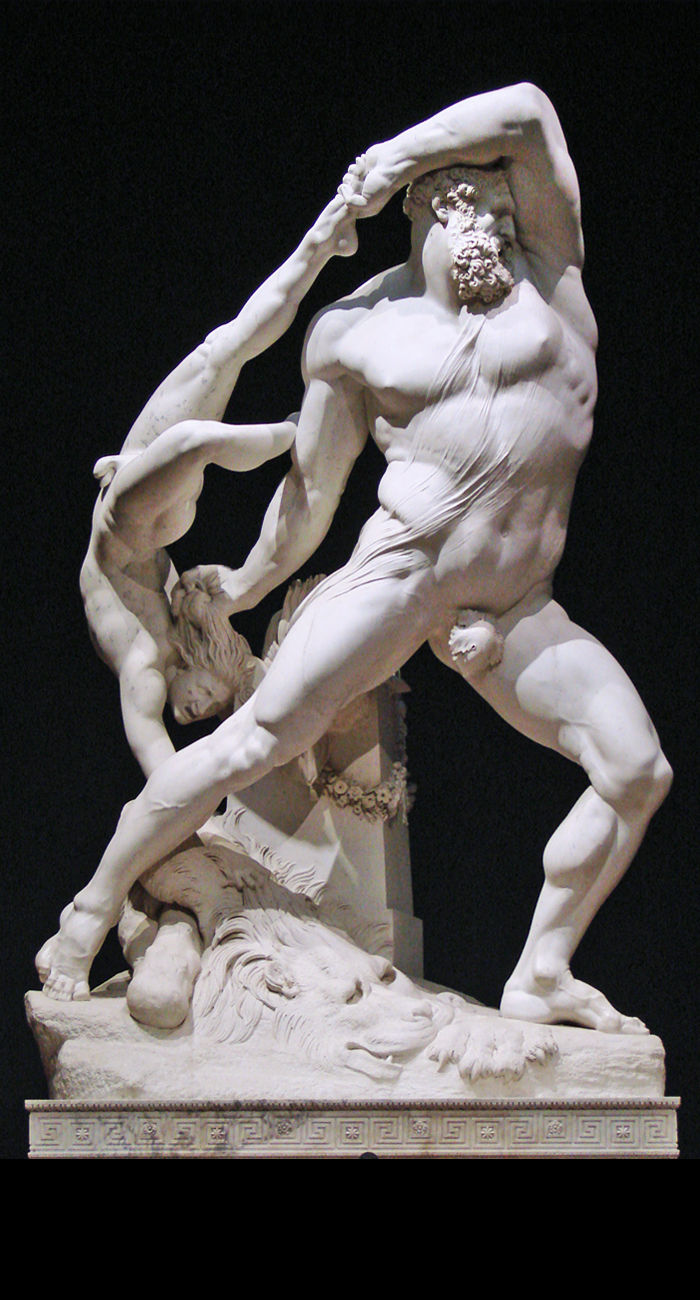
Antonio Canova, in this sculpture, shows us the perfect tension at the moment Hercules hurls Lichas through the air, enraged and already afflicted by the poison of that glorious tunic, now turned into his deadliest enemy, one he could never take off again. For so often, the very things that make us great, that title, that glory achieved, that recognition and triumph, become the poison that kills us by burning away all our pride.
The commission came to Canova from Prince Onorato Gaetani, an admirer of the celebrated group of Adonis and Venus by the same artist. His admiration for that sculpture was so great that the nobleman Gaetani decided to commission a marble group of Hercules and Lichas. From the moment of its first exhibition, the work was an immediate success, but later critics judged it harshly and linked it to patterns of academic execution, without real emotional involvement. The sculptural group follows an absolute geometric precision.
And yet, few sculptors were as far from this scene as Canova. His fame was built on grace, serenity and polished beauty: Psyche awakened by a kiss, the Three Graces, bodies that seem to breathe in calm. Here, the master of sweetness dared to take on fury. Two decades passed between the first project in 1795 and the finished marble in 1815, as if the artist had needed all that time to tame so much violence.
A Marble That Never Finishes Falling
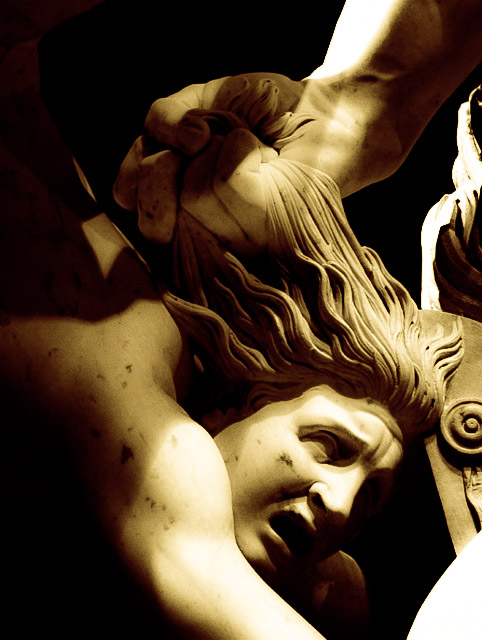
The hero appears at a moment of maximum muscular tension, just as he lifts the unfortunate young man by the foot, who resists in vain, clinging to the altar behind Hercules and to the lion skin abandoned at his feet. Lichas is firmly hoisted and suspended in the air a moment before being hurled into the waves of the sea. The group shows the arc of torsion of the two nude bodies, giving off an intense energy that makes plain the desperate climax in the young man's face and in the angry Hercules, framed by a thick curly beard. The hero would appear completely naked if it were not for the thin veil Canova used to cover the mass of muscles.
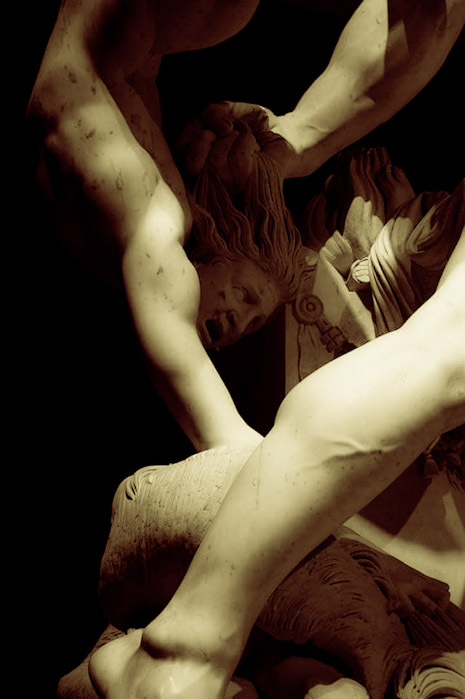
The most unsettling thing about the work is what it does not show: the fall. Canova chose the second before, the one in which Lichas is still alive, can still cling to the altar, can still hope. The viewer, who knows the myth, takes an uncomfortable place, the same as Deianira's: knowing what is coming and unable to stop it.
The Tunic as a Symbol
The myth left behind an expression that is still alive in several languages: the "tunic of Nessus," the gift that looks like love and brings ruin, the inheritance or favor that ends up destroying whoever receives it. Within this sculpture, that tunic is invisible, but it is present in every tense muscle of the hero.
There is also a cruel symmetry. The poison that kills Heracles is the same one he used to kill Nessus, and it comes from his most famous victory, the one over the Hydra. His own triumph returns to him turned into a sentence. The man who defeated every monster was defeated by the one he carried within: pride, fury, and a life of conquests that, without meaning to, sowed distrust in the person who loved him most.
And then there is Lichas, the only completely innocent figure in the story. He did not betray, he did not desire, he did not deceive: he only carried a package. Canova portrays him young and vulnerable before the mass of the hero, and that disproportion is the true moral message of the work: the wrath of the powerful almost always falls on the one with the least blame.
A Work Without a Flag
The work is based on Canova's careful study of some famous ancient marbles, such as the colossi of the Quirinal, the Farnese Hercules and the celebrated Hellenistic group of Laocoön and His Sons in the Vatican Museums. The French wanted to see in this work an allusion to France toppling the monarchy, but in Canova's work, unlike the works of Jacques-Louis David, there is no ideological reference, nor did the artist commit to identifying anyone. It was only the story of a mortal, a girl in love and cruel fate, which always arrives despite the protection of all the gods...
The Artwork:
Hercules and Lichas
Artist: Antonio Canova
Created: 1795 - 1815
Material: Marble
Dimensions: 335 cm
Location: National Gallery of Modern Art, Rome.