

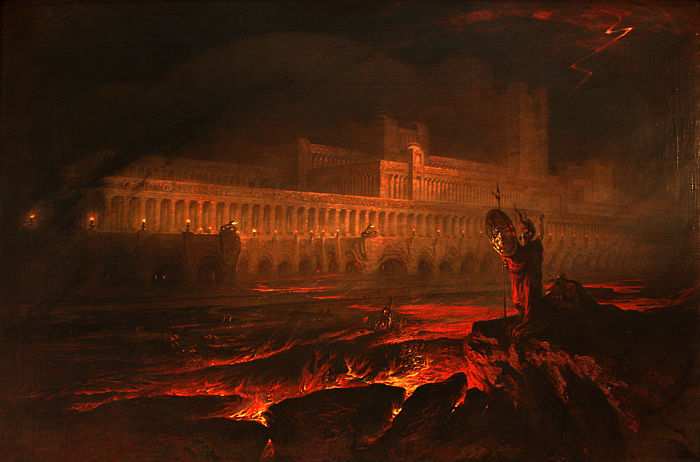
In 1841, the English painter John Martin unveiled one of his most ambitious creations: Pandemonium, a monumental depiction of the capital of Hell imagined by the poet John Milton in his celebrated work Paradise Lost. In the painting, Satan gazes proudly upon the gigantic palace he has just erected to rule over his followers, while thousands of demons gather at his feet, surrounded by lava, dark mountains, and a sky torn apart by lightning.
Yet behind this spectacular infernal vision lies a story connecting literature, Victorian architecture, and the problems faced by one of the most powerful cities of the nineteenth century. For although it appears to be a fantasy born from the depths of the abyss, part of Martin's inspiration may actually have come from London itself.
The Birth of an Infernal Capital
At the center of the composition, we see Satan standing on a rocky outcrop, gazing upon the city stretching out behind him. His posture conveys authority and satisfaction, like that of a sovereign who has just completed a work intended to perpetuate his power. Behind him rises a colossal palace, its architecture seemingly defying every human proportion. In the distance, endless ranks of demons advance in orderly formation toward their leader, forming small armies that contrast with the immensity of the landscape.
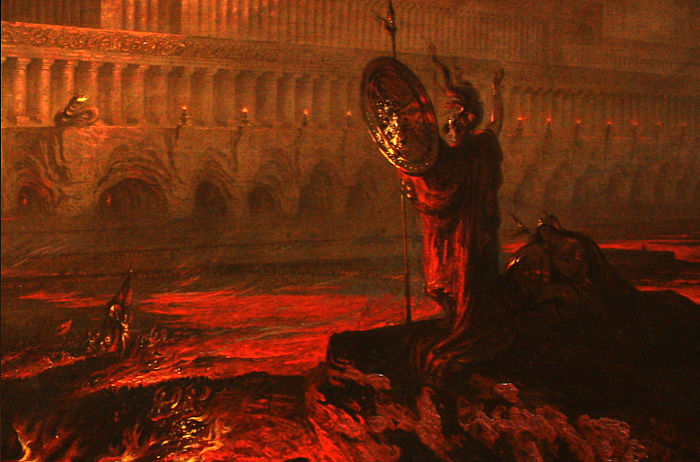
The entire setting is designed to create a sense of grandeur and menace. The incandescent lava illuminates the depths, the mountains seem to stretch toward an endless horizon, and lightning tears through the dark sky. Faced with such a spectacle, the figures appear insignificant, as though even the inhabitants of Hell were dwarfed by the magnitude of the city they have built.
This ability to portray monumental settings was one of the most recognizable characteristics of John Martin (1789–1854). The artist gained fame through his paintings of biblical catastrophes, apocalyptic landscapes, and historical or literary episodes in which nature and architecture take on extraordinary dimensions. His compositions frequently feature gigantic structures, abysses, storms, and tiny crowds, a combination that turns the viewer into a witness to events seemingly beyond the limits of ordinary experience.
In Pandemonium, Martin found a subject particularly suited to developing this visual language: the construction of the capital of Hell, one of the most powerful images in English literature.
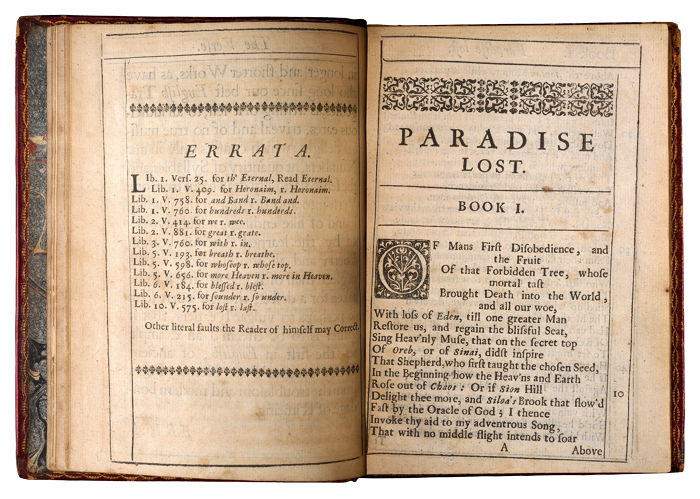
Excerpt from Book I of Paradise Lost, by the English poet John Milton, originally published in 1667.To the sound of the trumpet, a council was proclaimed, to be held at once in Pandemonium, the lofty capital of Satan and his nobles. From every regiment and every company, the finest among them, chosen by rank or election, were summoned. They arrived in hundreds and thousands, crowding the entrances, the spacious porches, and the immense hall. They swarmed, both on the ground and through the air... |
John Milton and the City of Satan
The inspiration for the painting comes from Paradise Lost, the epic poem published by John Milton in 1667. This monumental work recounts Satan's rebellion against God, the defeat of the rebellious angels, and their expulsion from Heaven. After falling into the depths of Hell alongside his followers, the fallen angel must face a new destiny in the infernal abyss.
But Milton does not portray Satan as a purely evil figure, defined by nothing more than his wickedness. Instead, he creates a complex character: intelligent, proud, and ambitious, whose thirst for power survives even after his defeat. His rebellion becomes a form of resistance, and his pride prevents him from accepting a subordinate position. From this attitude emerges one of the poem's most famous lines: “Better to reign in Hell than serve in Heaven.”
After awakening in the abyss, Satan gathers his followers and decides to establish a new center of power there. He does not intend merely to survive in the territory to which he has been condemned; he wants to build a city reflecting the grandeur of his former heavenly kingdom. Thus, Pandemonium is born: the palace destined to become the gathering place of all the demons.
The name has a particularly fitting meaning. It derives from the Greek roots pan, meaning “all,” and daimonion, associated with spirits or demons. Milton uses it to designate both the great assembly of infernal forces and the building that houses them.
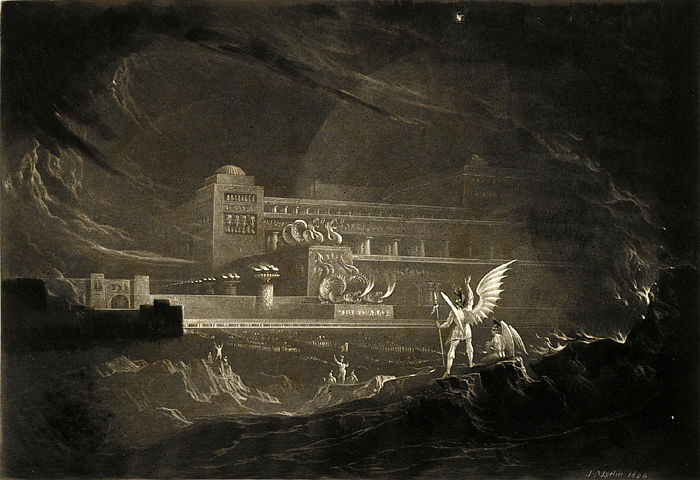
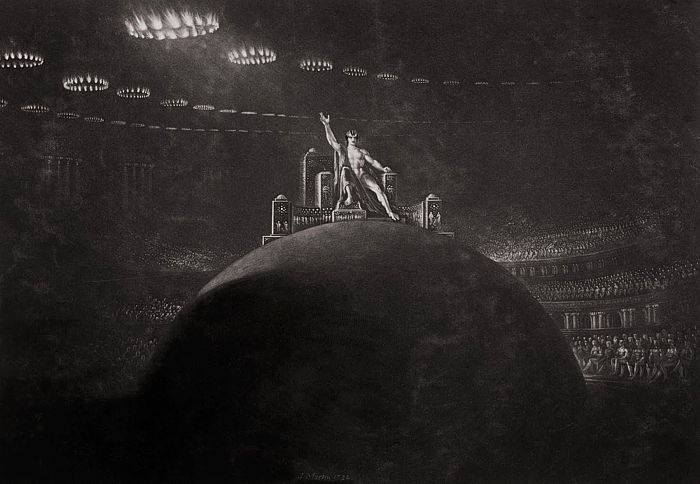
John Martin was deeply familiar with this literary universe. For years, he worked on a series of engravings inspired by Paradise Lost, translating the poet's visions into landscapes of immense proportions. These illustrations helped establish his reputation and demonstrated that his imagination found an ideal territory for artistic expression in epic literature.
Pandemonium, created in 1841, was his last major pictorial exploration of this universe. In it, he brought together many of the elements that had defined his career: a fascination with gigantic structures, catastrophic settings, and the tension between the ambitions of his characters and the forces surrounding them.
However, one detail in the composition leads us away from the world of literature for a moment and back to the England of Martin's own time.
An Infernal Palace Inspired by London
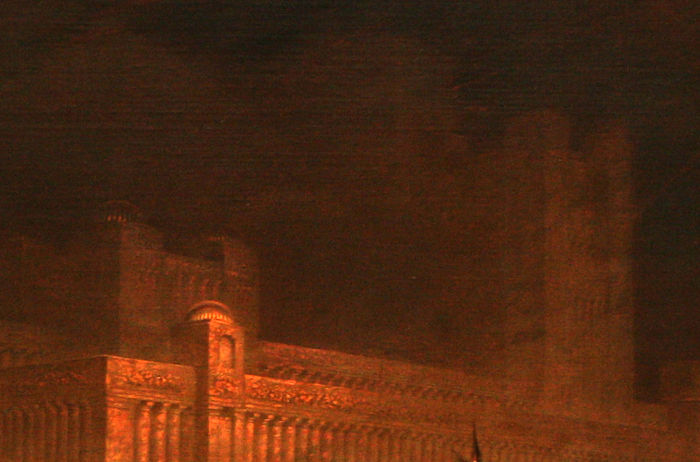
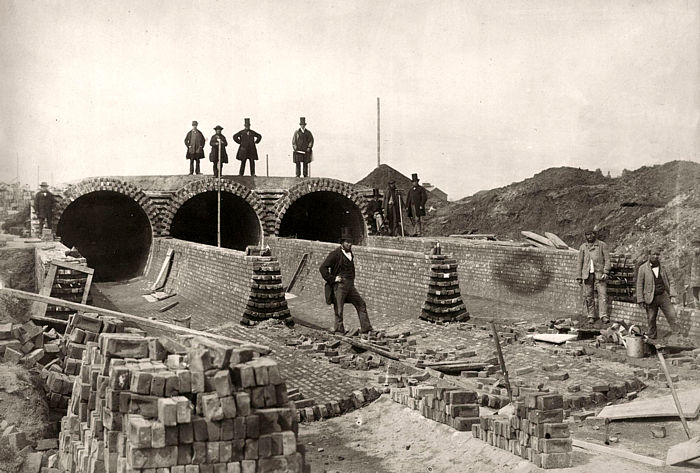
The gigantic building dominating the painting bears striking similarities to the Palace of Westminster, the seat of the British Parliament. This comparison becomes particularly interesting when we remember that John Martin was living in London during one of the city's great periods of architectural transformation.
In October 1834, a devastating fire destroyed much of the old Palace of Westminster. Its reconstruction gave rise to a major architectural project that would eventually become one of the most recognizable symbols of the English capital. The design was commissioned to Charles Barry, with the essential collaboration of Augustus Welby Northmore Pugin in the conception of many of its Neo-Gothic decorative elements. Construction began in 1840, just one year before Martin presented his painting.
The new building attracted enormous public interest and transformed London's urban landscape. Its monumental architecture, towers, and medieval inspiration offered striking imagery for an artist fascinated by grand structures.
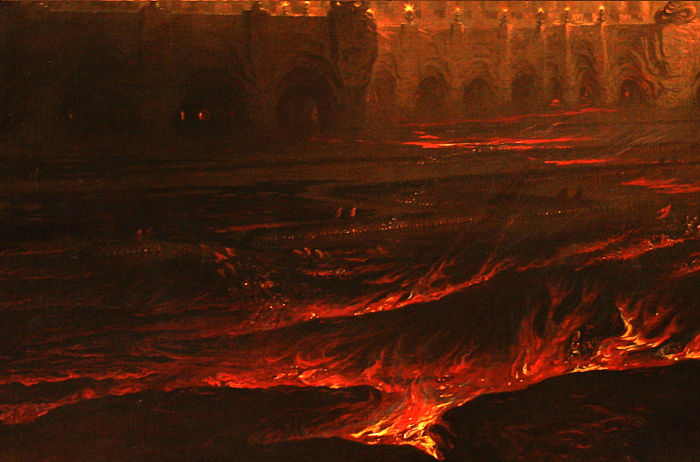
When looking at Pandemonium, it is almost impossible not to compare the two buildings. Their architectural arrangements, succession of vertical elements, and imposing scale reveal certain parallels. Martin, however, transforms this inspiration into something entirely different. His palace rises above enormous arches and appears to rest upon a river of incandescent lava. Its facade also features serpentine figures and monstrous elements that turn the structure into a genuine infernal fortress.
Architecture thus ceases to represent political power and the prosperity of a nation and becomes instead the symbol of an empire built upon destruction.
But the possible connection with London does not end with its buildings. The lower landscape of the painting also invites us to consider one of the most serious problems affecting the city during those years: the pollution of the River Thames.
The Thames: The City's Real River
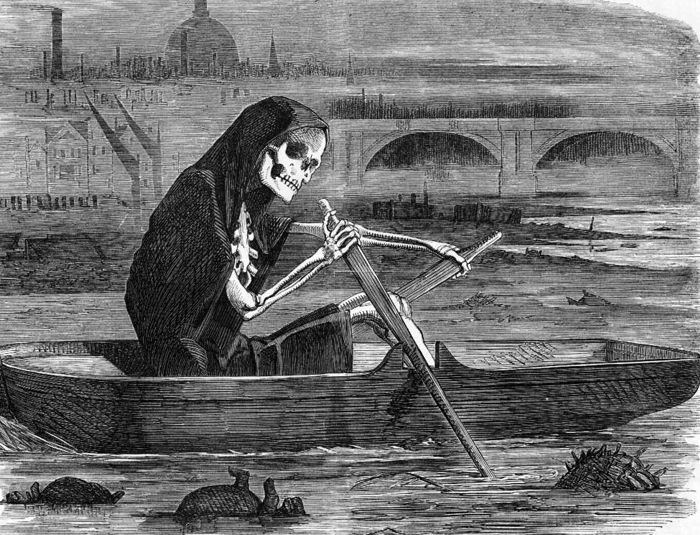
During the first half of the nineteenth century, London experienced extraordinary demographic and industrial growth. Urban expansion was not accompanied by adequate sanitation infrastructure, meaning that enormous quantities of human and industrial waste ended up in the Thames.
The river, which for centuries had been one of the city's main sources of wealth and communication, gradually became a serious public health problem. Its waters were contaminated, and outbreaks of diseases such as cholera caused deep concern among the population.
The situation would reach one of its most infamous moments in 1858, during the episode that went down in history as the Great Stink of London. That summer, high temperatures intensified the odors rising from the Thames to such an extent that they disrupted parliamentary activities and accelerated decisions to build a modern sewage system. However, the problem had been developing for decades.
John Martin was well aware of these difficulties. In addition to being a painter, he had a strong interest in engineering and major urban development projects. He had drawn up proposals to improve London's sanitation through sewage systems and canals designed to control waste and reduce pollution. His ideas were never implemented, but they reveal that behind the artist of apocalyptic visions was also a man concerned about the material conditions of the society in which he lived.
This aspect of his life allows us to explore a particularly intriguing interpretation of Pandemonium. The river of fire crossing the lower part of the composition may have evoked, for contemporary viewers, the environmental problems of a city growing without controlling the consequences of its own development. This is not a historically documented identification of the lava with the Thames, but rather an interpretation that gains meaning when we consider Martin's concerns about urban life.
In any case, the image of an extraordinary palace rising above a polluted river is a powerful metaphor: the outward grandeur of a civilization may conceal a far less admirable reality.
A Work That Divided the Critics
When Pandemonium was exhibited at the Royal Academy in London in 1841, reactions were mixed. Some viewers were impressed by the ambition of the composition and Martin's ability to depict a universe of almost unimaginable dimensions. Others considered his landscapes excessively theatrical, arguing that spectacle ultimately overshadowed every other artistic quality.
Among his best-known critics was John Ruskin, one of the leading figures in Victorian art criticism. Ruskin championed an approach to art closely connected with the observation of nature, honesty in representation, and moral values. From this perspective, Martin's grand apocalyptic scenes seemed exaggerated and artificial to him.
He went so far as to describe Martin's paintings as “pantomimes of the Apocalypse,” an expression reflecting the rejection his theatrical compositions inspired in certain circles.
Yet what some considered a flaw was precisely one of Martin's greatest strengths. The artist did not seek to offer a naturalistic representation of the world, but rather to create an extraordinary visual experience. His landscapes were designed to overwhelm the viewer, convey a sense of human insignificance, and transform painting into a spectacle of almost supernatural proportions.
In Pandemonium, this intention reaches one of its most ambitious expressions. The architecture, the crowds, and the landscape seem to form part of a single visual mechanism, with every element contributing to the depiction of the power of a kingdom built upon rebellion and pride.
The Frame: When Hell Overflows the Canvas
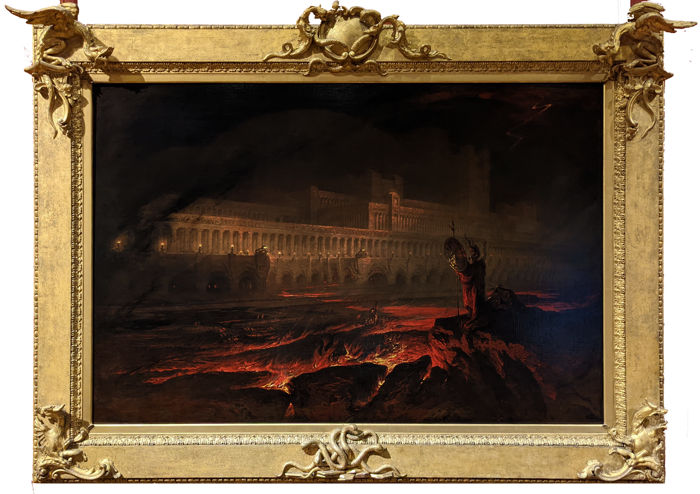
There is one final detail that makes this work even more extraordinary: its frame. Martin also took part in its design, conceiving it as an ornamental extension of the universe depicted in the painting.
Serpents, dragons, and fantastic creatures wind their way through its decoration, creating a transition between the scene and the surrounding space. The frame does not function merely as a boundary separating the artwork from its environment, but as an extension of its content. The same monstrous forces inhabiting the infernal landscape seem to continue around the painting, as though darkness itself could not be confined within the canvas.
This decision demonstrates just how deeply Martin understood the presentation of his works as part of the artistic experience. It was not enough to depict an extraordinary world: he also needed to create an object capable of conveying that sensation from the very moment viewers stood before it.
Today, Pandemonium is part of the collection of the Louvre Museum in Paris, where it retains its power to impress through the scale and complexity of its composition.
Beyond its literary inspiration, the painting also offers a glimpse into the concerns of a century marked by industrialization, urban growth, and an sometimes excessive faith in progress. John Martin imagined the capital of Hell as a monument to Satan's pride, but in doing so, he drew upon architectural forms and concerns belonging to his own world.
The paradox is fascinating: while his protagonist celebrates the construction of an empire destined to challenge Heaven, the artist seems to invite us to look at what lies beneath the foundations of great cities and the consequences that may be concealed by their apparent grandeur.
Perhaps that is why Pandemonium remains such a powerful image. We do not need to believe in demons or infernal cities to understand its warning. Sometimes, the darkest visions in art are born from looking too closely at the real world.
ARTWORK
Pandemonium
John Martin
Year: 1841
Art movement: Romanticism
Technique: Oil on canvas