

You've probably wondered what the two symbols that represent man and woman actually mean. Representing two planets, iron, copper and a pair of Olympian gods, the classic symbols for man and woman carry a lot of meaning in just a few lines.
Where the symbols come from
The symbols themselves are ancient, and the associations behind them go back to the dawn of civilization. After observing how the movements of celestial bodies like the Sun and the planets seemed to announce corresponding changes in events on our planet, the ancients eventually came to believe there was a causal relationship.

Naturally, then, ancient scholars began studying the skies to better predict and prepare for the future. They also came to associate different celestial bodies with their powerful gods: Mercury (Hermes), Venus (Aphrodite), Mars (Ares), Jupiter (Zeus), Saturn (Cronos), Neptune (Poseidon), Uranus (Caelus) and Pluto (Hades). The Sun was linked to Apollo, the Moon to Selene, and countless lesser gods to dozens of these planets' moons, as well as to certain stars and galaxies. They saw them in the sky and associated them with the gods.
Each celestial body, along with its god, was also associated with a particular metal. The Sun (Helios), for example, was associated with gold, Mars, god of war, was associated with the hard, red metal used to forge weapons, iron; and Venus with the softer metal that can turn green over time through oxidation, copper. And so on.
When writing about these metals, the Greeks referred to them by the names of their respective gods, and then, as now, these names were abbreviated using a combination of letters.
In the medieval period, European alchemists drew on these abbreviated symbols, which survived through the Enlightenment and were used by notable figures such as Carolus Linnaeus (the father of modern taxonomy who popularized binomial nomenclature) to refer to these metals in his 1735 work Systema Naturae.
What each symbol represents
Other branches of science and pseudoscience adopted these symbols as well; this is the case with the planetary symbols: those of the dwarf planet Pluto, the Moon and the Sun (along with the symbols for the zodiac constellations) were developed for use in both astronomy and astrology.
The astronomical symbol for the Sun is a shield with a circle inside it. Some believe this inner circle, or "boss," represents a central sunspot.
The symbol for Mercury represents the winged head and cap of Mercury, god of commerce and communication, resting on his caduceus (staff).
The symbol for Venus is designated as the female symbol, and is believed to be a stylized representation of this goddess of love's hand mirror.
The symbol for Earth shows a globe divided into four quarters by meridians.
The symbol for the Moon is a crescent.
The symbol for Mars represents the shield and spear of the god of war; it is also the male symbol.
The symbol for Jupiter is said to represent a hieroglyph of the eagle, Jupiter's bird, or to be the initial letter of Zeus with a line drawn through it to indicate an abbreviation.
The symbol for Saturn is believed to be an ancient scythe or sickle, since Saturn was the god of sowing as well as of time.
The symbol for Uranus combines devices representing the Sun plus the spear of Mars, since Uranus was the personification of the sky in Greek mythology, dominated by the light of the Sun and the power of Mars.
The symbol for Neptune is the trident (the long, three-pronged weapon or fork) of Neptune, god of the sea.
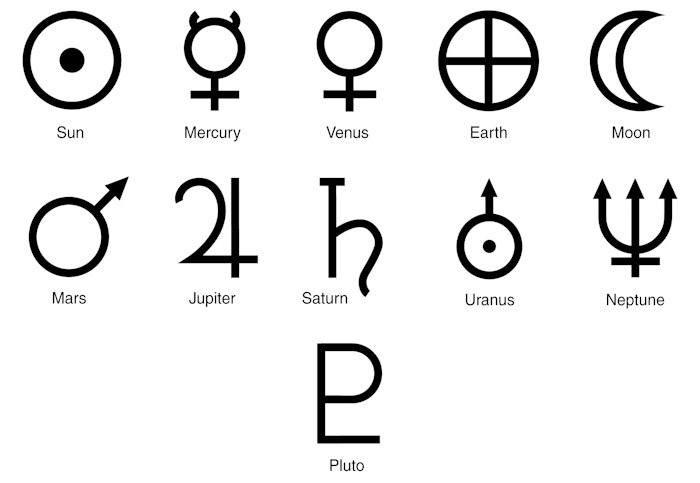
The symbol for the dwarf planet Pluto is a monogram formed by the letters P and L for Pluto (and also the initials of Percival Lowell, who predicted its discovery).
The mirror as a symbol in art
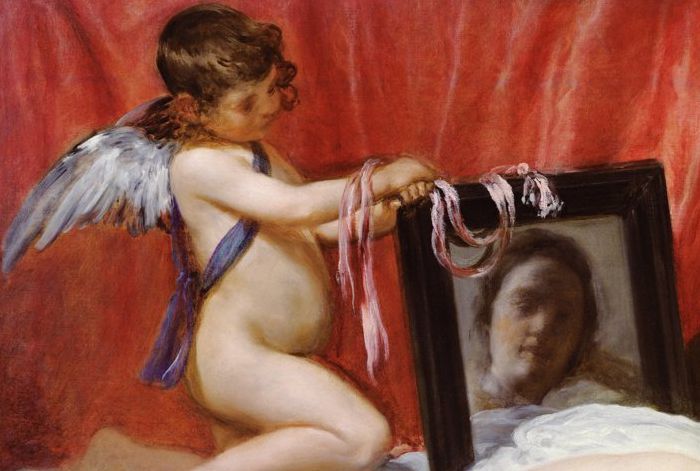
In art, the mirror can be read as a symbol. In Venus's case, the femininity derives from a pictorial depiction of the hand mirror popular in the classical world. There are some indications, though unconfirmed, that the sign of Venus's mirror may trace back to the Ankh, the ancient Egyptian symbol of life, understood as the key of life, the symbol of eternity.
Artists depicted it to express their admiration for the voluptuousness of a body that promised the delights of love and granted immortality through the provision of future generations.
It's no surprise that this object was essential in paintings from the vanitas genre ('vanity'): there it recalled the brevity, the fleetingness, the impermanence of earthly pleasures. This symbolism has survived through the centuries.
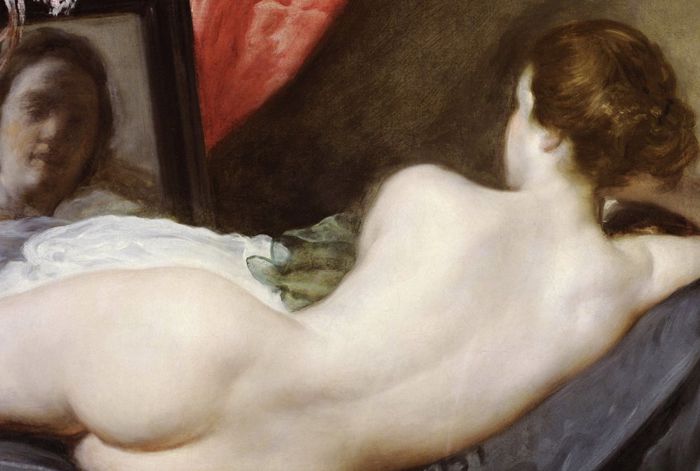
Perhaps it is the mirror that makes the viewer feel a kind of discord between the model's beautiful body and the plainness of her reflection. This is likely the case with this work: before Velázquez, the Spanish royal collections already held other mirror-holding Venuses, such as those by Titian and Rubens, which served as his direct references. The mirror in his Venus may remind us that its purpose is to bring us back to reality, beyond the vanity of our personal perception.
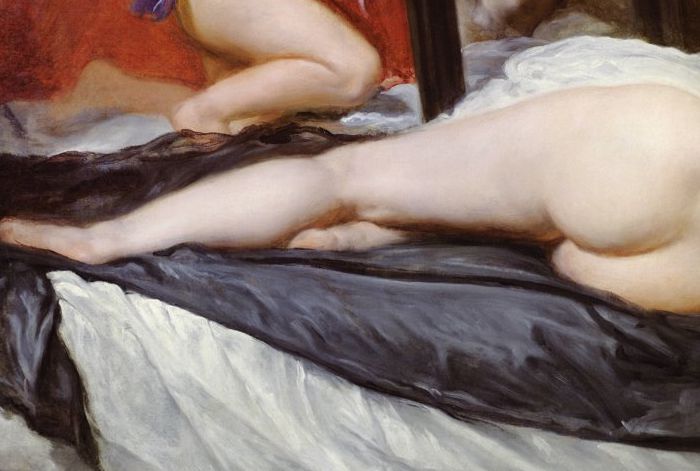
The Toilet of Venus is a painting by Velázquez, the most prominent painter of the Spanish Golden Age. It is currently held at the National Gallery in London, where it is known as The Toilet of Venus or The Rokeby Venus. The nickname "Rokeby" comes from Rokeby Park, a country house that at the time belonged to the county of Yorkshire (today part of County Durham), where the painting hung for much of the nineteenth century.
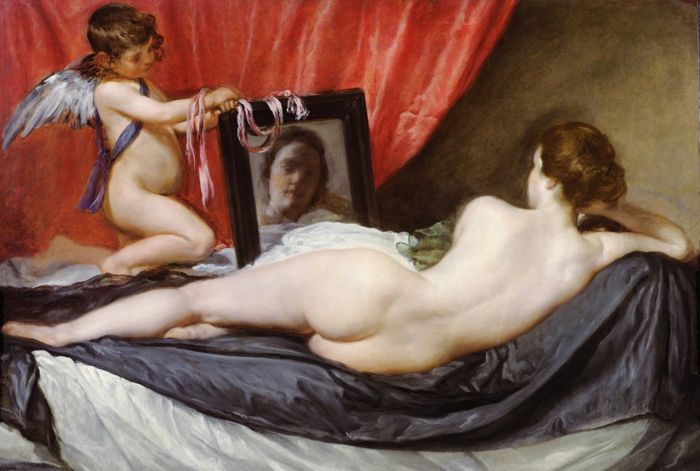
THE WORK
The Toilet of Venus
Artist: Diego Velázquez
Size: 1.22 m x 1.77 m
Period: Baroque
Date created: 1647-1651
Material: Oil painting
Location: National Gallery, London