

In the workshops of Florence, where the geniuses of the Renaissance forged immortal works, a creation was born that would capture the very essence of spring and the mysteries of rebirth. It was the hand of Sandro Botticelli, moved by divine muses, that captured on canvas the splendor of "La Primavera," a painting that would not only enchant generations but would become a portal to a world where gods, nymphs, and flowers wove an epic story.
In an enchanted forest, where the air was scented with floral aromas and the birdsong created celestial melodies, stood a meadow that served as the stage for the most momentous events in the cosmos. It was here that Spring, in all her glory, revealed her transformative power.
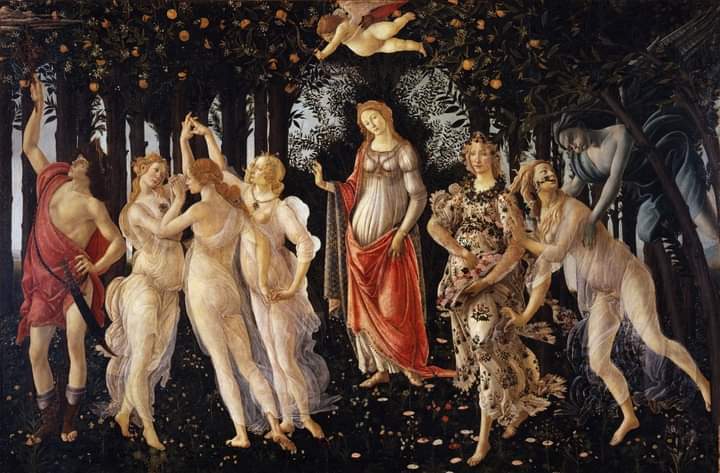
At the center of this idyllic scene was Venus, the goddess of love and beauty, radiating unparalleled grace. Dressed in a diaphanous cloak that barely covered her divinity, Venus stood under an arch of intertwined branches and flowers, which seemed to have been arranged by Nature herself to frame her splendor. Her eyes, full of wisdom and love, looked out toward the mortal and divine worlds, inviting them to participate in the celebration of renewed life.
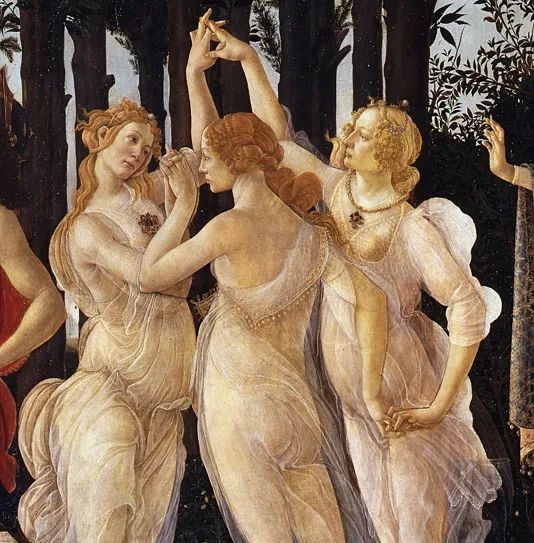
The Dance of the Graces
To her right, three ethereal figures danced in perfect harmony. They were the Three Graces, goddesses of charm, beauty, and creativity: Aglaea, Euphrosyne, and Thalia. Their movements were as soft as the whisper of the wind through the leaves. Every turn and every step was a poem in motion, a dance that resonated with the pure joy of existence.
Their light tunics billowed with every movement, revealing glints of alabaster skin that shone like stars under the sun. In their hands, they held garlands of flowers that scattered magical fragrances everywhere, infusing the air with an intoxicating power that stirred the spirits of all present.
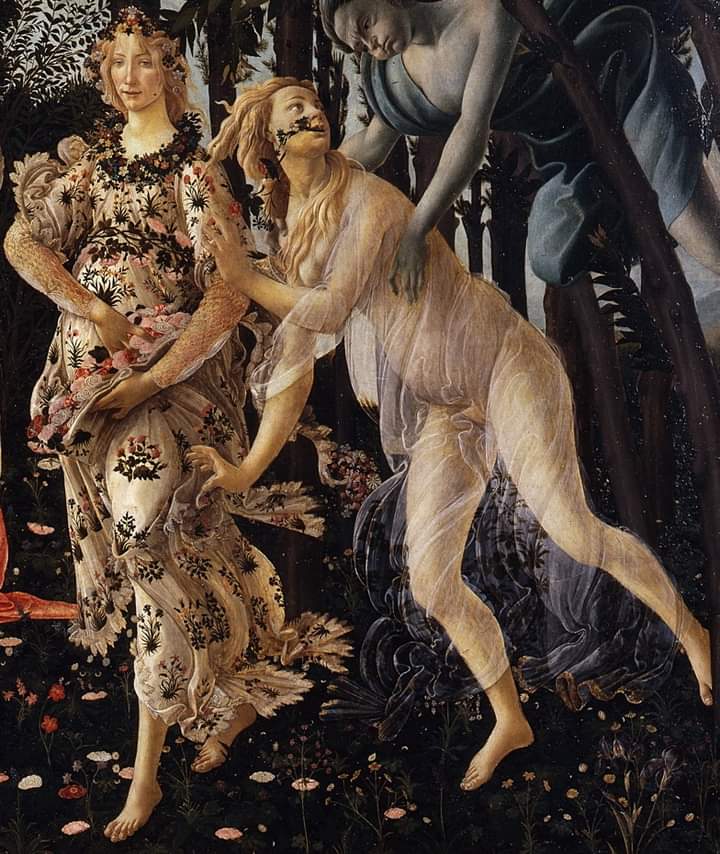
The Transformation of Chloris
To the left of Venus, a scene of divine metamorphosis unfolded. The spring wind, represented by Zephyrus, the god of the west wind, appeared in a contained fury. His gaze fixed on Chloris, a nymph of unequaled beauty, revealed both desire and intent. With a sudden movement, Zephyrus pounced on Chloris, took her in his arms, and enveloped her with his vital breath.
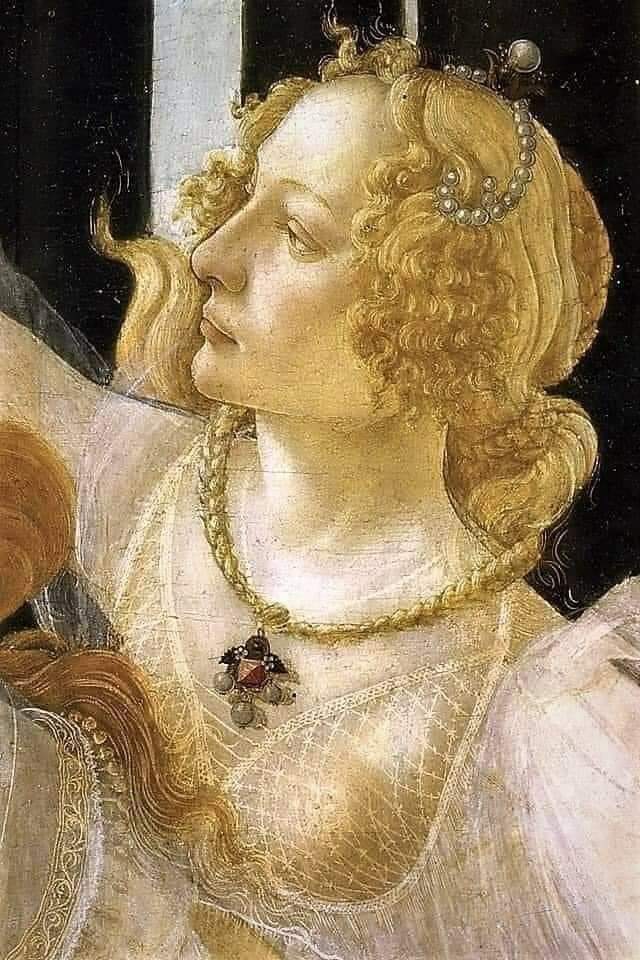
Chloris, although initially frightened, was soon transformed into Flora, the goddess of flowers. From her lips and hair sprouted flowers of all varieties, covering the meadow with a blanket of vibrant colors. Each step Flora took caused new flowers to spring up under her feet, turning the landscape into an eternal garden. Her dress, woven of petals and leaves, glowed with the light of a thousand springs, symbolizing fertility and renewal.
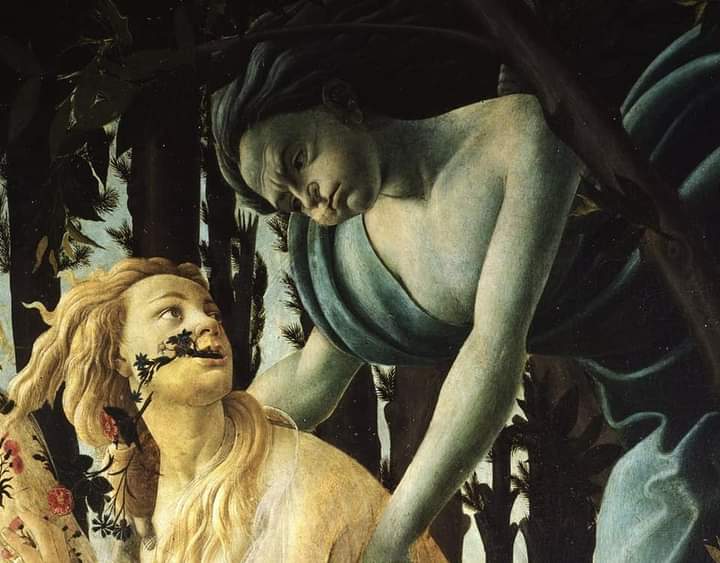
Mercury, Guardian of Paradise
To the left of the Three Graces, another god watched over this spring sanctuary. Mercury, the messenger of the gods, raised his caduceus to the sky, dispersing the clouds and protecting the garden from any threat. His figure, robust and athletic, emanated authority and serenity. His winged helmet and sandals indicated his speed and his ability to move between the mortal and divine worlds.
His eyes were fixed in the distance, watchful, ensuring that the peace and beauty of spring were not disturbed. He was a silent guardian, whose power was respected by all present. Under his protection, Venus's garden flourished without fear.
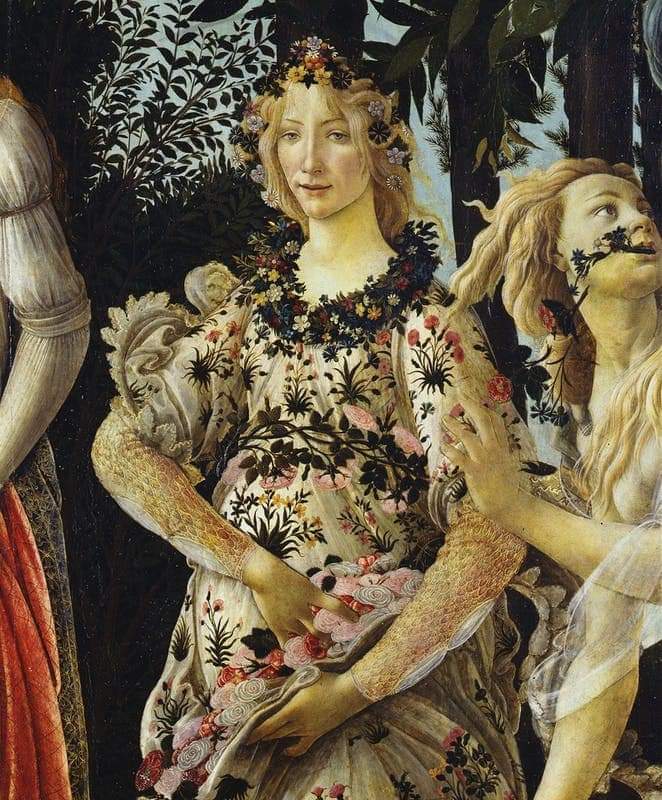
The Heart of Spring
In the heart of this epic scene, Venus remained the epicenter of everything. Her presence was not only a symbol of love and beauty but also of harmony and balance. Her raised hands, in a gesture of blessing, radiated a force that maintained the union between the gods and nature.
The forest surrounding this magical clearing was full of secrets and promises. The ancient trees, witnesses to countless springs, whispered legends of ancient times. The crystal-clear streams that meandered through the meadow sang songs of life and renewal. And the sky, clear and bright, was a canvas reflecting the glory of creation.
The Ecstasy of Nature
As the sun rose in the firmament, its golden light bathed the meadow in a warm and welcoming glow. The colors intensified, the shadows lengthened, and the air filled with vibrant energy. It was as if the universe itself were celebrating Spring.
The creatures of the forest, attracted by the magic of this moment, timidly approached. Birds of iridescent plumage fluttered around the goddesses, their trills mingling with the music of nature. Butterflies, in a symphony of colors, danced in the air, while deer and rabbits watched from the shadows of the trees, captivated by the beauty they witnessed.
Divine Symbology
Every detail of Botticelli's "La Primavera" was loaded with symbology. The flowers that covered the meadow were not mere ornaments, but symbols of the virtues and cycles of life. Roses represented love and passion; lilies, purity and renewal; and daisies, innocence and simplicity.
The Three Graces, with their celestial dance, represented the interconnection between beauty, joy, and creativity. Their presence was a reminder that life, in all its forms, was a constant dance of creation and celebration.
Flora, born from the transformation of Chloris, symbolized the eternal promise of spring: that even after the darkest winter, life always is reborn, bringing with it hope and beauty.
The Legacy of Spring
Botticelli's "La Primavera" is not only a masterpiece of Renaissance art but also an epic narrative that transcends time. It is a celebration of beauty, transformation, and rebirth, themes that resonate deeply in the human experience.
Throughout the centuries, this work has inspired poets, musicians, and artists, reminding them of the eternal promise of spring and the magic that resides in nature. Every brushstroke by Botticelli captures a moment of this epic story, inviting those who contemplate it to immerse themselves in a world where gods and nature coexist in a harmonious dance.
The Distinction of Times
It is essential to differentiate between the entities we have mentioned. Chronos, the god of time, is an imposing figure marking the inexorable passage of seconds, minutes, and hours. In contrast, Kronos, the Titan, is a force of destruction and fear, devourer of his children to maintain his dominance. Aion, for his part, represents cyclical time, eternal renewal, and the perpetual cycle of the seasons.
In "La Primavera," it is not the passage of linear time nor the threat of devouring that is celebrated, but the constant rebirth, the eternal promise of renewal that Aion symbolizes. Botticelli, with his divine brush, invites us to contemplate this dance of life and to find in it the inspiration for our own stories of transformation and beauty.
And so, in the enchanted meadow of "La Primavera," under the watchful eye of Venus and the protection of Mercury, life continues its eternal dance, reminding us that no matter how dark the night, there will always be a new dawn full of promises and flowers.
Ovid's lines explain how Zephyrus violated the nymph Chloris and then made her his bride:
(As she spoke, her lips breathed forth spring roses):
'I, now called Flora, was Chloris: the first letter of my name in Greek was corrupted in the Latin language.
I was Chloris, a nymph of those happy fields,
where, as you have heard, fortunate men lived.
It would be difficult to speak of my form with modesty,
but it brought my mother a god as a son-in-law.
It was spring, I wandered: Zephyrus saw me: I left.
He followed me: I fled: he was the stronger,
and Boreas had given his brother authority to rape
by daring to steal a prize from the house of Erechtheus.
However, he repaired his violence by granting me
the name of bride, and I have nothing to complain about in bed.
I enjoy perpetual spring: the season is always bright,
the trees have leaves: the ground is always green.
I have a fruitful garden in the fields that were my dowry,
fanned by the breeze and watered by a flowing spring.
My husband filled it with flowers in abundance
and said: "Goddess, be mistress of the flowers."
Often I wished to count the colors laid out there,
but I could not, there were too many to count.
As soon as the frosty dew is shaken from the leaves,
and the varied foliage warmed by the sun's rays,
the Hours gather dressed in colorful robes
and collect my gifts in slender baskets.
The Graces, at once, approach and intertwine
crowns and garlands to bind their celestial hair.'
The Work
La Primavera
Artist: Sandro Botticelli
Periods: Italian Renaissance
1478/1482. Format
2.03 x 3.14 m
Materials: Tempera on panel
Location: Uffizi Gallery
¿Te gustaría que te ayude con algo más mientras esperas la reparación de tu notebook, o prefieres que preparemos los borradores de los siguientes artículos?